The Ultimate Guide to TWS Earbuds
If you’ve spent any time sourcing audio products, you’ve noticed the term “TWS” gets thrown around a lot — sometimes correctly, sometimes not. Buyers ask for “TWS earbuds” when they mean any wireless earbud. Sellers list “true wireless” earbuds that technically aren’t. And the underlying technology has moved fast enough that a lot of the sourcing knowledge from three or four years ago is already outdated.
This guide is meant to close that gap. Whether you’re an Amazon seller vetting your first supplier, a wholesale buyer trying to understand what you’re actually paying for, or a brand owner deciding between chipset platforms, you’ll find a practical, technically grounded breakdown of how TWS earbuds work, what separates a good pair from a mediocre one, and how the manufacturing side of this industry actually operates.
In this guide, you’ll learn what TWS earbuds are, how the technology works, which specifications actually matter, and how to evaluate a reliable TWS earbuds manufacturer before placing an order.
What Are TWS Earbuds? A Quick Primer
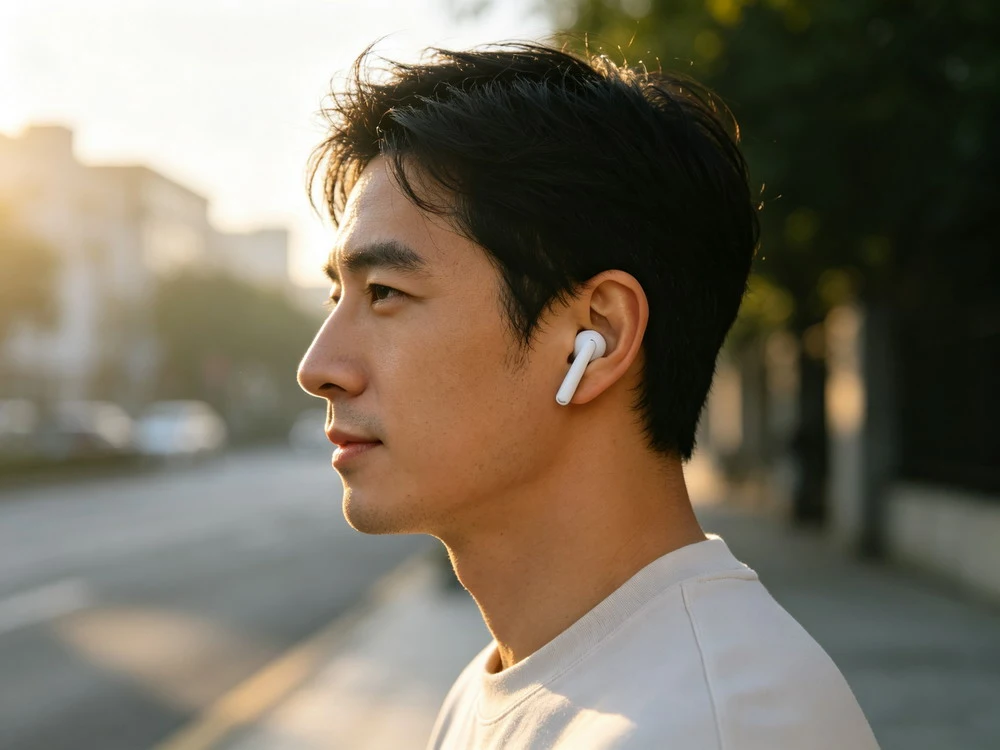
TWS stands for True Wireless Stereo. It describes earbuds that have no physical cable at all — not between the two earpieces, and not between the earpieces and your phone. Each earbud is a fully independent unit with its own battery, its own antenna, and its own driver.
That sounds obvious now, but it wasn’t always the standard. Understanding where TWS came from helps explain why certain design choices — like the master-slave chip architecture we’ll get into later — still shape how these products are built today.
The Difference Between TWS, Wireless, and Bluetooth Earbuds
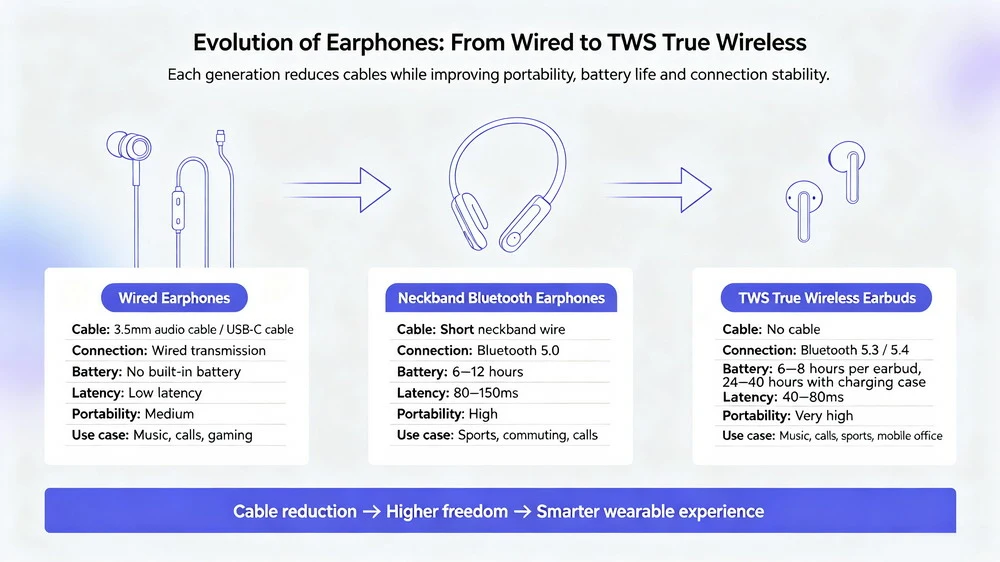
Not every wireless earbud is a TWS earbud. “Wireless earbuds” is a broad category that includes neckband-style earphones, where the two earpieces are connected by a cord that sits behind the neck. Those are wireless from the phone, but not truly wireless between the earpieces.
“Bluetooth earbuds” is even broader — it just means the product uses Bluetooth instead of a wired 3.5mm jack. TWS is a subset of Bluetooth earbuds, specifically the ones with zero cables anywhere in the system. For sourcing purposes, this distinction matters because buyers searching “TWS earbuds” on Amazon or Google are almost always looking for the fully cordless format, and listing a neckband product under that keyword will hurt conversion and invite returns.
Quick Comparison: TWS vs Wireless vs Bluetooth Earbuds
| Type | Cable Between Earbuds | Uses Bluetooth | Typical Use |
|---|---|---|---|
| TWS earbuds | No | Yes | Fully wireless consumer audio |
| Wireless earbuds | Sometimes | Usually | Includes neckband designs |
| Bluetooth earbuds | Depends | Yes | Any Bluetooth audio product |
A Brief History: From Wired to True Wireless
Bluetooth earphones existed for over a decade before TWS became viable. Early Bluetooth headsets in the 2000s were single-ear mono devices built for calls, not music. Stereo Bluetooth headsets followed, but they still relied on a wire connecting left and right.
The real shift happened around 2016, when Bluetooth chipsets got small enough and power-efficient enough to fit a complete radio, battery, and DSP into a single earpiece the size of a coffee bean. Once that hardware existed, the wire between the two earpieces became unnecessary. That’s the moment TWS went from a niche engineering demo to a mainstream product category, and it’s also when the supply chain in Shenzhen and the wider Pearl River Delta began scaling to meet demand.
Within about three years, what had been a premium, early-adopter product became a mainstream commodity category, with price points spreading from flagship $150+ earbuds down to sub-$20 unbranded pairs sold in bulk. That price compression is part of why understanding the underlying technology matters so much for buyers today — at the low end especially, corners get cut in ways that aren’t visible from a spec sheet alone, and the only way to catch them is to know what to ask about.
How TWS Technology Actually Works
This is the part most buyers skip, and it’s the part that actually determines product quality. Two earbuds that look identical on a spec sheet can behave completely differently depending on how the internal architecture handles connection and audio sync. It’s also the section I get the most follow-up questions on from clients, because the difference between “sounds fine in the showroom” and “sounds fine after three weeks of daily commuting” almost always traces back to one of the design choices below.
The Two-Chip vs Master-Slave Architecture
In most TWS designs, one earbud acts as the “master” and the other as the “slave.” The master earbud connects directly to your phone over Bluetooth, receives the full stereo audio stream, and then relays one channel to the slave earbud over a secondary wireless link — usually near-field magnetic induction (NFMI) or a second Bluetooth connection.
This architecture is cheap and works well enough for most use cases, but it has two known weaknesses. First, the master earbud drains battery faster than the slave, since it’s doing double duty. Second, if you’re standing in a crowded space with a lot of RF interference, the master-to-slave link can stutter before the phone-to-master link does — which is why you sometimes hear a dropout in only one ear.
The alternative is a true dual-transmission architecture, where both earbuds connect independently to the phone. Qualcomm’s TWS+ and newer chipset platforms from Airoha and Bestechnic (BES) support this. It costs more to implement but solves both problems: battery drain evens out, and each earbud has its own independent link to the source, which is more resilient to interference.
TWS+ and True Wireless Stereo Plus
TWS+ is Qualcomm’s branding for the dual-connection approach described above. It’s not a Bluetooth standard — it’s a feature built into specific Qualcomm QCC chipsets (like the QCC3040 and QCC5100 series) that requires a compatible phone on the other end to actually deliver the independent dual-stream benefit. Without a TWS+-capable phone, the earbuds fall back to standard master-slave relay behavior.
This is a point worth flagging to clients who ask why their earbuds “should” perform better than they do. The chipset can support a feature, but the real-world benefit depends on the phone too. It’s also worth noting that TWS+ style dual connections put more strain on maintaining audio sync between earpieces, since both are receiving independent streams rather than one relayed copy — which brings us to the last piece of this puzzle.
Audio sync — making sure left and right channels play at exactly the same moment — is one of the hardest problems in TWS engineering, regardless of which architecture a product uses. A delay of even a few milliseconds between earpieces is audible as smearing or a hollow stereo image, and it’s one of the first things an experienced reviewer will notice in a critical listening test even if they can’t immediately name what’s wrong.
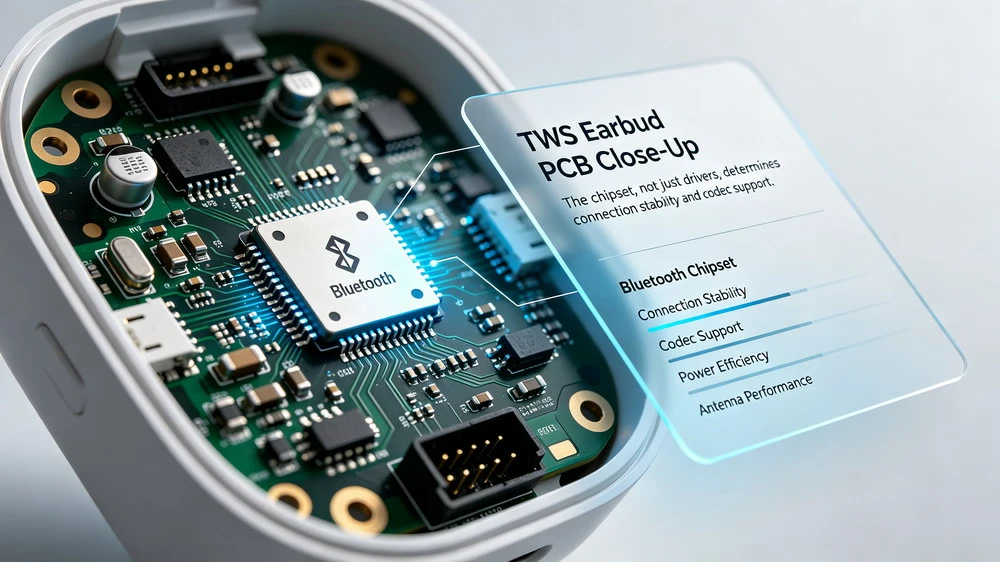
Manufacturers solve this with tight clock synchronization protocols built into the chipset firmware. This is one of the reasons chipset selection matters more than most buyers realize: a cheap, uncertified chipset without mature sync algorithms will produce earbuds that sound “off” even if the drivers themselves are decent. This is an area where established platforms — Qualcomm QCC, Airoha, BES, and Jieli — have a real, measurable edge over unbranded alternatives, because years of firmware refinement go into solving exactly this problem, refinement that a cloned or unlicensed chip design simply hasn’t had time to accumulate.
Bluetooth Versions Explained
Every TWS earbud spec sheet lists a Bluetooth version, and buyers frequently ask which one they need. The honest answer: it matters less than people think for casual listening, and more than people think for range, battery life, and multipoint features.
Bluetooth 5.0 vs 5.1 vs 5.2 vs 5.3 vs 5.4
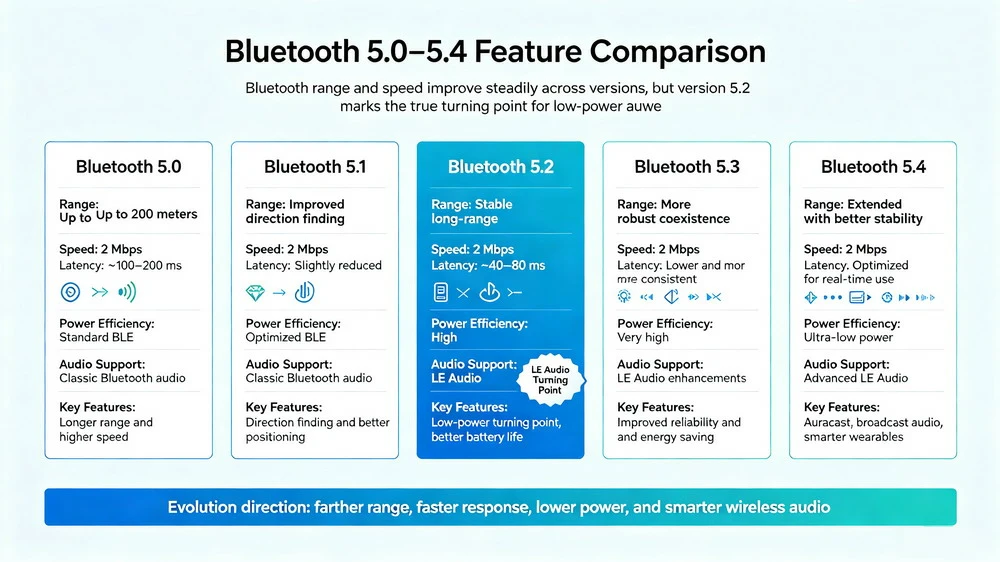
Bluetooth 5.0, released in 2016, doubled the range and quadrupled the data speed of Bluetooth 4.2. It’s still a perfectly usable baseline for budget earbuds today.
Bluetooth 5.1 added direction-finding capability, which isn’t really relevant to earbuds but does bring minor stability improvements.
Bluetooth 5.2 is the version that matters most for TWS specifically, because it introduced LE Audio and the LC3 codec framework (more on that below), along with better power efficiency for low-energy connections.
Bluetooth 5.3 refined connection stability and reduced interference in crowded RF environments — genuinely useful in places like transit stations or open-plan offices where dozens of Bluetooth devices compete for the same spectrum.
Bluetooth 5.4, the newest widely adopted version as of 2026, adds encrypted advertising and improved periodic sync, which mostly benefits accessibility features and multi-device pairing rather than raw audio quality.
For sourcing purposes: 5.2 or higher is a reasonable minimum to ask for in any new product line launching this year, mainly because it unlocks LE Audio compatibility going forward.
| Bluetooth Version | Main Improvement | Buyer Impact |
|---|---|---|
| 5.0 | Longer range and higher speed | Reliable baseline |
| 5.1 | Direction finding | Minor stability improvements |
| 5.2 | LE Audio framework | Better future compatibility |
| 5.3 | Improved stability | Better crowded-area performance |
| 5.4 | Enhanced broadcast features | Future multi-device applications |
LE Audio and the Auracast Standard
LE Audio is a newer low-power Bluetooth audio framework that runs on the LC3 codec instead of the older SBC/AAC codecs used in Classic Bluetooth. It uses less power for the same audio quality, which translates to either longer battery life or a smaller battery — useful for compact earbud designs where every cubic millimeter matters.
Auracast, built on top of LE Audio, allows a single audio source to broadcast to an unlimited number of compatible earbuds simultaneously — think airport gate announcements, gym equipment, or public TVs broadcasting audio directly to anyone’s earbuds. It’s still early in adoption, but it’s becoming a checkbox item on RFQs from brand clients who want their product line to be forward-compatible.
For Amazon sellers, the practical impact of Bluetooth version shows up in three places: connection range, battery efficiency, and how many devices the earbuds can remember and switch between. A buyer comparing two nearly identical earbud listings will often use Bluetooth version as a tiebreaker, so it’s worth getting the spec sheet right and not just copying whatever the previous product cycle used. Multipoint pairing — the ability to stay connected to two devices at once, like a laptop and a phone, and switch seamlessly between them — is another spec that’s become table stakes on anything above entry-level, and it depends as much on firmware quality as on the raw Bluetooth version number.
Audio Codecs and Sound Quality
The codec is the compression format used to send audio over Bluetooth. This is a spec that gets confused with Bluetooth version constantly, but they’re separate things: the Bluetooth version is the radio protocol, and the codec is what rides on top of it.
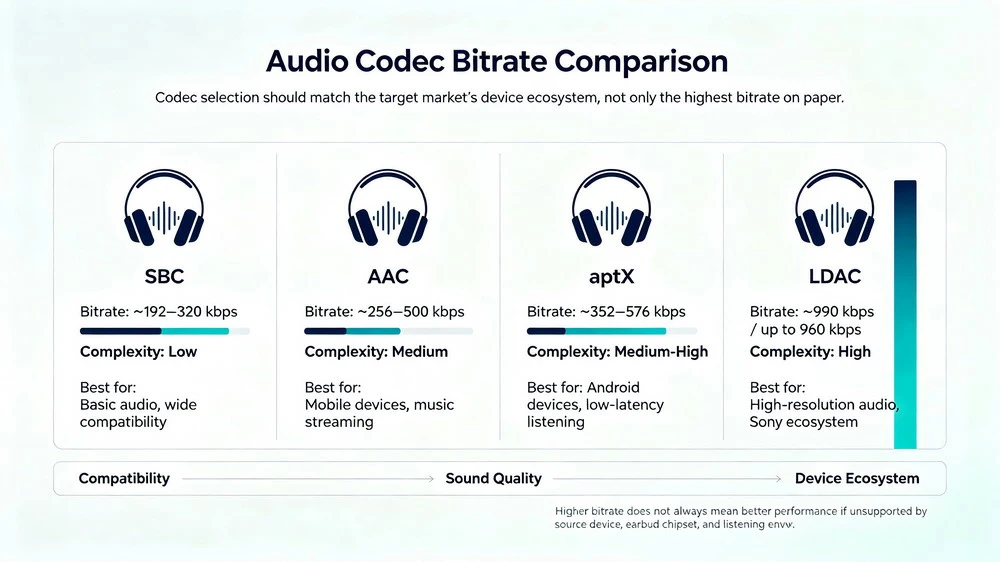
SBC, AAC, aptX, and LDAC Compared
SBC (Subband Coding) is the mandatory baseline codec every Bluetooth audio device must support. It’s not particularly efficient and introduces noticeable compression artifacts at low bitrates, but it works with literally every Bluetooth source device, which is why it’s still the fallback in every product.
AAC is the codec Apple devices favor. It handles compressed audio well and is a safe choice if a large share of your target market uses iPhones, since AAC performance on iOS is generally better than SBC.
aptX (and its higher-tier variants aptX HD and aptX Adaptive) is Qualcomm’s codec family, optimized for Android devices with lower latency and better bitrate handling than SBC. aptX Low Latency specifically matters for gaming-focused earbuds, where audio lag behind on-screen action is a dealbreaker.
LDAC, developed by Sony, supports the highest bitrates of the group and is marketed as “hi-res” audio over Bluetooth. It’s mostly relevant for premium product lines targeting audiophile buyers, since the bitrate advantage is only audible with good source material and a discerning ear.
| Codec | Best For | Notes |
|---|---|---|
| SBC | Universal compatibility | Required baseline codec |
| AAC | iPhone users | Strong iOS performance |
| aptX | Android and gaming | Lower latency options |
| LDAC | Premium audio | Best for high-end products |
Choosing between these codecs is a sourcing decision as much as an engineering one. A product targeting the general Amazon US market benefits most from SBC + AAC support, since that covers both iOS and Android baseline compatibility. A product targeting Android-heavy markets or gaming audiences benefits from adding aptX, and gaming-specific lines should specifically confirm aptX Low Latency support rather than assuming standard aptX covers it. Chasing LDAC support for a budget or mid-range product is usually not worth the added chipset cost, since most buyers in that segment won’t notice the difference, and the added cost is better spent on driver quality or ANC performance instead.
ANC Technology Deep Dive
Active Noise Cancellation is one of the most requested features in RFQs right now, and also one of the most misunderstood. Buyers frequently ask for “the best ANC” without specifying what environment the earbuds need to perform in, which leads to mismatched expectations later — ANC tuned well for a droning airplane cabin isn’t necessarily tuned well for the sharper, more variable noise of a city street or an open-plan office, and a factory that only tests against one noise profile can end up delivering a product that underperforms in the environment your actual customers use it in.
Feedforward vs Feedback vs Hybrid ANC
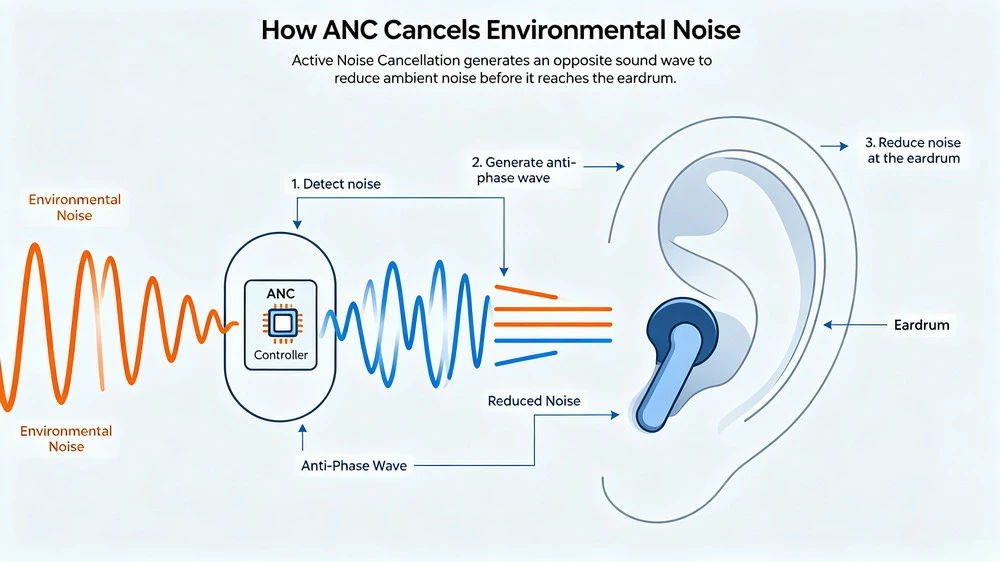
Feedforward ANC uses a microphone on the outside of the earbud to sample ambient noise before it reaches your ear, then generates an inverse sound wave to cancel it. It’s good at handling broad, steady noise like airplane engine hum, but less precise because it doesn’t account for how the earbud’s own physical seal affects what actually reaches the eardrum.
Feedback ANC places the microphone inside the earbud, closer to the eardrum, and cancels noise based on what’s actually being heard. It’s more accurate for low-frequency rumble but can be prone to a whistling artifact if not tuned carefully.
Hybrid ANC combines both microphones and processes them together, which is why nearly every serious ANC product on the market today — regardless of price tier — uses a hybrid setup. Pure feedforward or pure feedback ANC is now mostly a budget-tier shortcut.
ANC Chipsets: Qualcomm QCC, Airoha, and BES
The ANC algorithm itself lives in the chipset’s DSP, and this is another area where platform choice has a real, audible effect. Qualcomm’s QCC30xx and QCC51xx series have mature ANC implementations with good adaptive noise profiling. Airoha (formerly MediaTek’s Bluetooth division) offers a strong price-to-performance ratio and has become a common choice for mid-range ANC earbuds coming out of Shenzhen factories. Bestechnic’s BES chips have carved out a niche in cost-sensitive ANC products, with adequate but less refined noise cancellation depth compared to the top Qualcomm tiers. Jieli chips are typically reserved for entry-level products without ANC, or with a very basic single-mic implementation.
For a factory evaluating chipset options — which is a conversation I have with clients constantly — the honest tradeoff is: Qualcomm gives you the best-tuned ANC experience but at a higher BOM cost, Airoha gives you 80% of the performance at a meaningfully lower price, and BES is the value play for buyers who need “ANC” on the spec sheet more than they need best-in-class cancellation depth.
ENC vs ANC: Call Quality vs Noise Cancellation
ENC (Environmental Noise Cancellation) is frequently confused with ANC, but they solve different problems. ANC cancels noise for the person wearing the earbuds, improving what they hear. ENC cancels background noise picked up by the microphone during calls, improving what the person on the other end of the call hears. A product can have ENC without ANC, and vice versa, though most mid-to-premium earbuds now ship with both. When a buyer says they want “noise cancelling earbuds for the office,” it’s worth clarifying whether they mean blocking out ambient noise (ANC) or sounding clear on calls in a noisy space (ENC) — the answer changes which chipset and mic array configuration actually fits the brief. In practice, most mid-range and premium earbuds now bundle both, using a multi-microphone array (often four to six mics total across both earpieces) with the DSP running separate algorithms for playback-side ANC and call-side ENC simultaneously, but budget-tier products frequently market “noise cancelling” while only actually implementing one of the two — worth confirming in writing before finalizing a spec sheet with a new factory.
Battery Technology in TWS Earbuds
Battery performance is one of the most heavily scrutinized specs in reviews and one of the easiest to misrepresent on a listing, which makes it worth understanding at a technical level.
Battery Capacity and Playtime Benchmarks
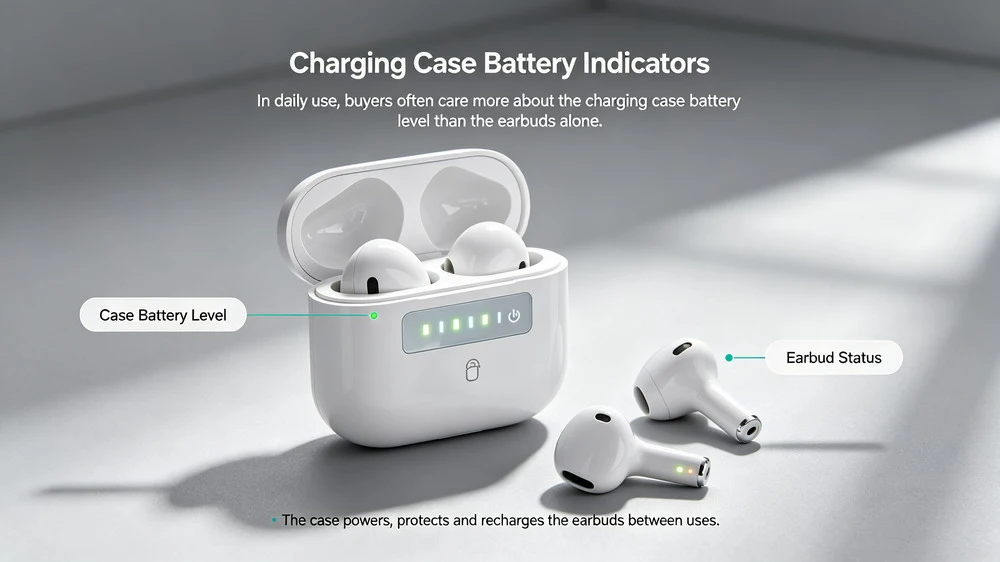
Individual earbuds typically carry a lithium battery in the 40–60mAh range, while the charging case holds a larger battery, usually 400–600mAh, to deliver multiple full recharges on the go. Manufacturers advertise total playtime as “earbud battery plus case recharges combined” — a pair might list 8 hours of continuous playback but “32 hours with the case,” which refers to four additional full charge cycles.
It’s worth noting that ANC significantly reduces playtime, sometimes by 20–30%, because the DSP processing and extra microphones draw continuous power. A listing that shows the same battery life with ANC on and off should raise a flag during factory vetting — either the spec is inflated, or the ANC implementation is weak enough that it’s barely drawing extra power in the first place, which isn’t much better.
It’s also worth asking factories how they measure their advertised playtime figures. Some test at 50% volume with ANC off in a quiet room, which produces flattering numbers that don’t hold up in real-world use at 70-80% volume on a commute. A reputable supplier should be able to tell you the exact test conditions behind their playtime claim, not just hand over a number.
Fast Charging and Wireless Charging Cases
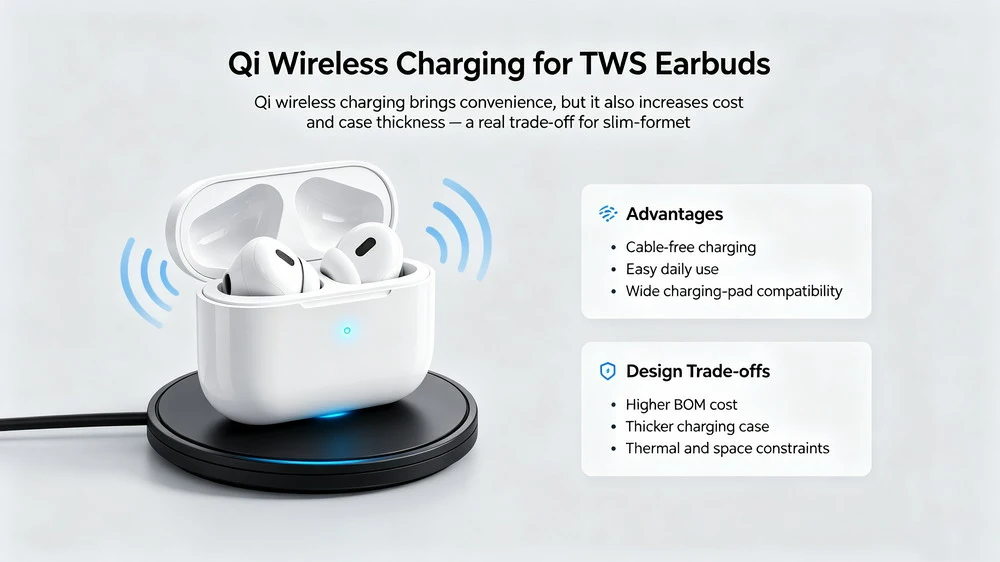
Fast charging on TWS earbuds usually delivers something like one hour of playback from a 10-to-15-minute charge — genuinely useful for the “forgot to charge overnight” scenario. Wireless charging cases, using the Qi standard, have become close to standard on mid-range and premium product lines, though they add cost and slightly increase case thickness, which matters for buyers targeting a slim, pocket-friendly form factor.
Battery Safety and UN38.3 Certification
Any product shipping lithium batteries internationally needs UN38.3 certification, which confirms the battery has passed a series of safety tests covering altitude simulation, thermal cycling, vibration, shock, and short circuit resistance. This isn’t optional — freight forwarders and airlines require the UN38.3 test report before they’ll accept a shipment, and Amazon requires it for listings involving battery-powered products. Any factory that can’t produce a current UN38.3 report for the specific battery cell used in your product is not one you want to be sourcing from, regardless of how good the sample sounds.
Earbud Types: In-Ear, Open-Ear, and OWS
The physical form factor is often the first decision a brand makes, and it shapes almost every downstream engineering choice — from driver size to ANC feasibility to battery placement. Getting this decision right upfront saves a lot of rework later, since switching form factors mid-development usually means starting the acoustic tuning process over from scratch.
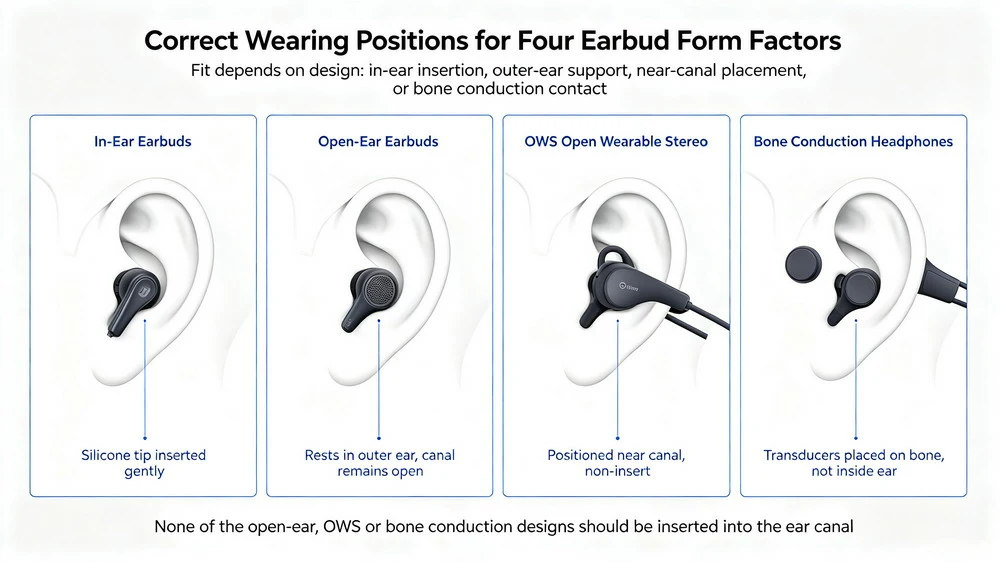
In-Ear TWS Earbuds
In-ear earbuds use silicone or foam tips that create a seal inside the ear canal. This seal is what enables strong passive noise isolation and makes effective ANC possible, since the sealed cavity gives the DSP a predictable acoustic space to work with. The tradeoff is comfort for extended wear and total awareness of surroundings — some users find a sealed fit fatiguing after a couple of hours, and it’s genuinely unsafe for activities like outdoor running near traffic. In-ear remains the dominant form factor for a reason: it’s the easiest to get right acoustically, it supports the widest range of ear tip sizes for a secure fit, and it’s the format most consumers already understand and expect, which keeps return rates lower than newer form factors that require more customer education.
Open-Ear Earbuds
Open-ear earbuds sit near or around the ear without sealing the canal, letting ambient sound through naturally. This has become one of the fastest-growing categories in the last two years, driven largely by fitness users and people who want to stay aware of their surroundings — during commutes, workouts, or just long days at a desk where a sealed fit feels uncomfortable. The tradeoff is real: without a seal, ANC is far less effective (there’s no closed cavity to cancel within), and bass response tends to be thinner unless the driver and acoustic chamber are specifically tuned to compensate.
Open-Ear Wireless Stereo (OWS)
OWS earbuds are a specific open-ear design that hooks over the ear, typically using a small driver housing that sits just outside the ear canal, aimed inward. This is distinct from bone conduction — OWS still uses air conduction, just without sealing the ear. OWS has become popular in the sports and outdoor category specifically because it stays secure during movement in a way that some other open-ear formats don’t. From a manufacturing standpoint, OWS designs require more attention to the ear hook’s flex and durability, since that component takes repeated mechanical stress that in-ear silicone tips never experience.
Bone Conduction and Air Conduction Headphones
Bone conduction headphones transmit sound by vibrating the skull bones near the ear, bypassing the eardrum’s normal air-conduction pathway entirely. This leaves the ear canal completely open and unobstructed, which is popular for safety-conscious buyers — cyclists and runners who need to hear traffic clearly. Air conduction open-ear designs (including most OWS products) achieve a similar “ear stays open” outcome through direct, focused sound projection rather than skull vibration, generally delivering fuller sound quality but slightly less total ear-canal openness than true bone conduction. Buyers sometimes use these terms interchangeably, but they’re different transduction mechanisms with different acoustic tradeoffs, and it’s worth clarifying which one a client actually means before quoting a project.
—
Certifications and Compliance for Global Markets
This section gets less attention than the technical chapters, but it’s often the deciding factor in whether a shipment clears customs or gets held.

FCC, CE, RoHS
FCC certification is required for any wireless device sold in the United States, confirming the product’s radio emissions fall within allowed limits and won’t interfere with other devices. CE marking serves a similar purpose for the European Economic Area, covering both radio compliance (under the Radio Equipment Directive) and general product safety. RoHS restricts the use of specific hazardous substances — lead, mercury, cadmium, and several others — in electronic components, and is required for products sold into the EU regardless of where they’re manufactured.
BQB and UKCA
BQB (Bluetooth Qualification Body) certification confirms the product’s Bluetooth implementation actually complies with the Bluetooth SIG’s technical specifications — this is separate from and in addition to FCC/CE radio testing, and it’s specific to the chipset and antenna design used. UKCA marking became the UK’s post-Brexit equivalent to CE marking, and while there’s been ongoing transition flexibility for CE-marked goods sold in the UK, buyers targeting that market specifically should confirm current requirements with their compliance consultant rather than assuming CE alone is sufficient going forward.
A factory that already holds these certifications for its core product lines — rather than needing to test from scratch for every new SKU — saves real time and cost on a new project. This is one of the practical advantages of working with an established manufacturer like Tashells Audio, whose existing certified platforms mean a new earbud variant can often reuse prior compliance testing rather than starting the certification clock over.
Manufacturing and Sourcing TWS Earbuds from China
For most brands and Amazon sellers reading this, the technology sections above exist in service of one goal: sourcing a product that actually performs the way the spec sheet claims. This section covers how that sourcing process works in practice — the terminology, the pricing structure, and the geography that makes this industry function the way it does.
OEM vs ODM: What’s the Difference
OEM (Original Equipment Manufacturer) means the factory builds a product to your specifications — your design, your branding, sometimes your chosen components — and manufactures it under your label. ODM (Original Design Manufacturer) means the factory already has a base design and lets you customize branding, packaging, and sometimes minor spec details on top of it.
ODM is faster and cheaper to get to market since the engineering work is already done — it’s a good fit for sellers who want a solid, proven product without a long development cycle. OEM gives more control and differentiation but requires a longer development timeline and typically a higher MOQ to justify the tooling and engineering cost.
MOQ, FOB, and Pricing Structures
MOQ (Minimum Order Quantity) is the smallest order a factory will accept, and it varies enormously based on whether you’re buying an existing ODM design (MOQs can be as low as a few hundred units) or a fully custom OEM product (often 1,000–5,000+ units, sometimes higher depending on tooling costs).
FOB (Free On Board) pricing means the quoted price covers the product up to being loaded onto the shipping vessel at the origin port — the buyer takes on freight, insurance, and import duties from that point forward. This is the most common pricing term in earbuds sourcing, and it’s worth confirming exactly which port the FOB price references, since factories in different parts of the Pearl River Delta may quote from Shenzhen, Guangzhou, or Hong Kong depending on their logistics setup. It’s also worth asking whether the quoted FOB price includes packaging, accessories (charging cable, spare ear tips), and outer carton, since some quotes cover only the bare unit and case, with everything else billed as an add-on later in the process — a detail that can shift landed cost more than buyers expect once it’s added up across a full order.
Pearl River Delta Supply Chain Advantage
The Pearl River Delta — anchored by Shenzhen, Dongguan, and Guangzhou — is where the overwhelming majority of the world’s TWS earbuds are designed and assembled, and the reason isn’t just labor cost. It’s density. Chipset suppliers, driver manufacturers, PCB fabs, injection molding shops, and battery cell suppliers all operate within a couple of hours of each other. That proximity means a factory can iterate on a prototype in days rather than weeks, because a component change doesn’t require waiting on a shipment from another province or another country. For buyers evaluating where to source, this ecosystem density is a real, structural advantage that’s difficult for manufacturing hubs elsewhere to replicate quickly.

Choosing the Right TWS Manufacturing Partner
With hundreds of factories in Shenzhen alone claiming to build TWS earbuds, the practical challenge for buyers isn’t finding a manufacturer — it’s telling the good ones apart from the ones that will cut corners on chipset quality or certification paperwork. A trade show booth and a slick product catalog don’t tell you much on their own; the vetting has to go a level deeper than that.

Key Questions to Ask Suppliers
Ask which specific chipset platform they use, not just “which brand” — a factory that vaguely says “Qualcomm” without naming the exact model number is often hedging. Ask to see current, unexpired certification documents (FCC, CE, RoHS, BQB, UN38.3) for the specific product, not a generic company-level certificate. Ask about their ANC tuning process and whether they can share frequency response measurements, not just marketing claims. And ask what their sample lead time and MOQ actually are in writing, since verbal quotes during a trade show conversation often shift once a formal RFQ is submitted.
Red Flags in Factory Vetting
Watch for factories that can’t explain the difference between feedforward and hybrid ANC when asked directly — that usually means they’re reselling a reference design without understanding it. Be cautious of suppliers offering the lowest MOQ in the market alongside premium spec claims (LDAC, hybrid ANC, Bluetooth 5.4) at a price point that doesn’t cover the BOM cost of those components — something is being substituted, and it’s usually the chipset. And treat any factory that’s reluctant to share a sample before a large deposit as a serious risk signal. It’s also worth being wary of suppliers who resist a third-party quality inspection before shipment — a factory confident in its own build quality generally has no problem with an outside inspector verifying it, and reluctance there is often a sign that something in the production run doesn’t match the approved sample.
How to Evaluate an Engineering-Focused TWS Manufacturer
An engineering-focused TWS manufacturer China should provide exactly the kind of transparency that many buyers need during supplier evaluation — clear chipset specification (not vague brand-dropping), certification documents that are current and product-specific, and a willingness to walk buyers through ANC tuning and codec support before a sample order is even placed. For brands and Amazon sellers evaluating suppliers for open-ear, ANC, or OWS product lines specifically, that level of engineering transparency tends to save real time during the vetting process — you’re not guessing at what’s actually inside the earbud.
TWS Earbuds for Amazon Sellers and Private Label Brands
The private label earbuds category on Amazon is dense with competition, which means product differentiation and listing compliance both matter more than they did even two years ago. A generic ODM shell with a swapped logo is a harder sell in 2026 than it was even a couple of product cycles back, simply because there are more of them competing for the same search terms.
Private Labeling and Custom Branding
Most ODM factories offer some tier of customization beyond just a logo — custom case colors, custom packaging, sometimes minor firmware adjustments like touch-control gesture mapping or voice prompt language. It’s worth clarifying upfront exactly what’s customizable at your MOQ tier, since some factories reserve deeper customization (like custom molded case shapes) for higher order volumes. Packaging deserves particular attention here — unboxing experience has become a meaningful driver of review sentiment on Amazon, and a factory that treats packaging as an afterthought rather than a design decision is leaving conversion and repeat-purchase rate on the table.
Amazon Listing Compliance Considerations
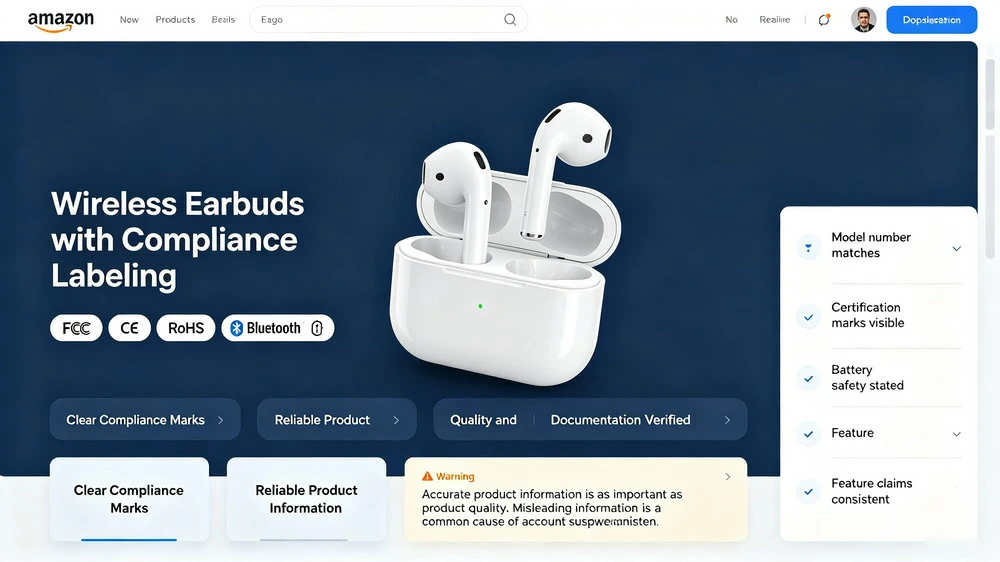
Amazon requires documentation for battery-containing products, including UN38.3 test reports and, for products sold in the US, FCC ID registration. Listings claiming specific certifications (like ANC or specific Bluetooth versions) that don’t match the actual product specs are a common cause of suspension after a buyer complaint or a competitor report — so it’s worth confirming your listing copy matches the factory’s actual test documentation exactly, rather than copying language from a competitor’s listing that might not apply to your specific unit.
Future Trends in TWS Technology
Sourcing decisions made today should account for where the category is heading over the next product cycle or two, not just where it stands right now. None of the trends below are hypothetical — all three are already shipping in some tier of product on the market, the question is really just how fast they move down into the price segment you’re building for.
AI-Powered Earbuds and Real-Time Translation
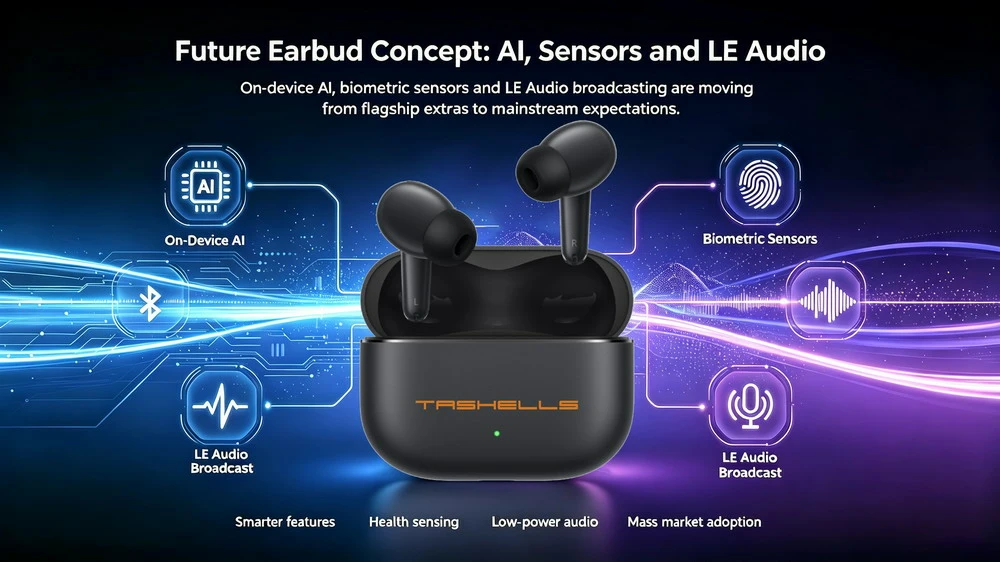
On-device AI processing is starting to show up in premium TWS earbuds — real-time language translation, AI-enhanced ANC that adapts to specific noise environments rather than using a fixed profile, and voice assistant integration that runs partly on the earbud’s own chip rather than routing everything through the phone. This trend is likely to filter down into mid-range products over the next couple of years as chipset costs for on-device AI processing continue to drop.
Health Sensors and Biometric Tracking
Heart rate sensors and in-ear temperature sensors are increasingly common in premium sport-focused earbuds, positioning TWS earbuds as a secondary wearable alongside smartwatches. This adds bill-of-materials cost and design complexity — sensor placement inside an earbud is a tighter engineering problem than in a wristband — but it’s becoming a genuine differentiator in the fitness and outdoor segment specifically.
LE Audio Adoption Outlook
As more phones ship with LE Audio support by default, expect Auracast broadcast features to move from a novelty spec-sheet item to something buyers actively expect, particularly for earbuds marketed toward travel, commuting, or shared-listening use cases. Factories that have already integrated LE Audio-capable chipsets into their current product lines will have a real head start adapting to this shift compared to those still running Classic Bluetooth-only platforms.
Frequently Asked Questions
What does TWS stand for in earbuds? TWS stands for True Wireless Stereo — earbuds with no cable connecting the two earpieces to each other or to the source device.
Are TWS and Bluetooth earbuds the same thing? Not exactly. All TWS earbuds use Bluetooth, but not all Bluetooth earbuds are TWS — neckband-style earphones use Bluetooth but still have a physical cable connecting the two earpieces, so they don’t count as true wireless.
Which Bluetooth version should I look for in new TWS earbuds? Bluetooth 5.2 or higher is a reasonable baseline for products launching now, mainly because it unlocks LE Audio and the LC3 codec framework, which matters increasingly for future compatibility.
Does ANC significantly reduce battery life? Yes. Running ANC continuously typically cuts playback time by 20–30% compared to ANC off, since the extra microphones and DSP processing draw continuous power.
What’s the difference between ANC and ENC? ANC cancels ambient noise for the person wearing the earbuds. ENC cancels background noise picked up by the microphone so the person on the other end of a call hears you more clearly. They solve different problems and a product can have one without the other.
Can open-ear earbuds have effective ANC? Not really, at least not to the degree sealed in-ear earbuds can. ANC relies on a closed acoustic cavity to work effectively, and open-ear designs don’t create that seal by definition.
What certifications do I need to import and sell TWS earbuds in the US and EU? At minimum, FCC certification for the US, CE marking and RoHS compliance for the EU, BQB certification for the Bluetooth implementation itself, and UN38.3 for the lithium battery. Requirements can vary slightly depending on additional features like wireless charging.
What’s a typical MOQ for custom TWS earbuds? It depends heavily on whether you’re customizing an existing ODM design or building a fully custom OEM product. ODM customization can start as low as a few hundred units, while custom OEM development often requires 1,000 to 5,000+ units to justify tooling costs.
Is LDAC worth requesting for a mid-range product? Usually not. LDAC’s bitrate advantage is most noticeable with high-quality source material and attentive listening, which tends to matter more for premium, audiophile-oriented product lines than for general mid-range earbuds.
What’s the difference between OEM and ODM manufacturing? OEM means the factory builds to your custom specifications and design. ODM means you’re customizing an existing base design the factory already developed, which is typically faster and comes with a lower MOQ, but offers less differentiation than a fully custom OEM product.
How much does it cost to manufacture TWS earbuds? Manufacturing cost depends on chipset, battery size, ANC capability, tooling, packaging, and order quantity. Entry-level ODM products can be produced at lower cost, while custom OEM designs require higher engineering investment.
How do I choose a reliable TWS earbuds supplier? Evaluate the chipset platform, certification documents, testing process, sample consistency, MOQ requirements, and the supplier’s ability to explain technical decisions clearly.
Final Thoughts
TWS earbuds sit at an unusual intersection of consumer electronics, RF engineering, and global supply chain logistics — a category where a chipset decision made in a Shenzhen factory directly determines whether a customer in Ohio leaves a five-star or a one-star review. Understanding the technology well enough to ask the right questions is, in practice, the difference between sourcing a product you can stand behind and sourcing one you’re hoping customers won’t scrutinize too closely.
Whichever segment you’re building for — sealed in-ear ANC, open-ear sport earbuds, or OWS designs — the fundamentals covered here apply. Know your chipset platform, know your codec support, know your certifications, and work with a manufacturer that can explain all three without hesitation.
Ready to Develop Your Own TWS Earbuds Product?
If you are planning a private label, OEM, or ODM earbud project, the right supplier can make the difference between a product that looks good on paper and one that performs reliably in the market.
Talk with an engineering-focused TWS earbuds manufacturer about chipset selection, ANC tuning, certifications, customization options, and production requirements before starting your next project.
Next steps:
Request TWS earbuds samples
Review OEM/ODM options
Discuss your target market and specifications