What Are AI Translation Earbuds?
In short: AI translation earbuds are wireless earbuds built with microphones and an AI-powered app that convert spoken conversation from one language into another, in near real time, through the earbud itself.
A customer messages you a link to a pair of earbuds that claim to translate 40 languages in real time and asks, “Can we make something like this?” Before you can answer that question — or answer it to a supplier — you need to know what you’re actually being asked to build.
AI translation earbuds are not a firmware update on a standard TWS earbud. They are a different product category, with a different bill of materials, a different app layer, and a different set of sourcing risks. This guide breaks down how the translation pipeline actually works, what separates a real translation product from a marketing claim, and what to check before you put your brand name on one.
The Short Answer: What AI Translation Earbuds Are Made Of
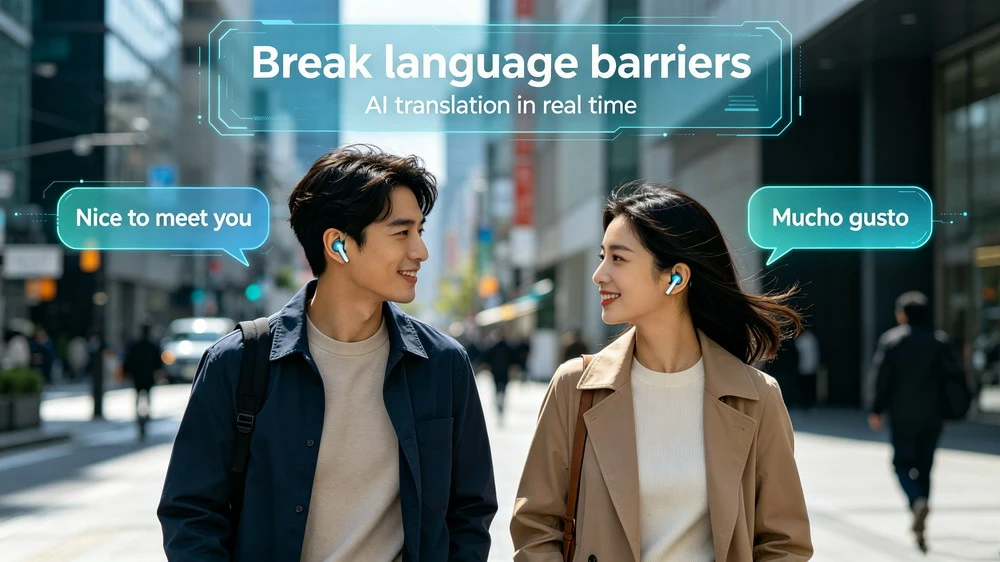
AI translation earbuds combine a Bluetooth connection to a companion app with AI-driven speech recognition and translation software. Unlike a regular pair of TWS earbuds that only plays back audio you send it, a translation earbud is part of a closed-loop system: microphone, speech-to-text engine, machine translation engine, and text-to-speech engine.
Most of that system runs on the paired phone or in the cloud, not inside the earbud chip itself. The earbud is the input/output device. The “AI” in AI translation earbuds is mostly software sitting on the other end of a Bluetooth link — not a chip inside the earbud doing large-language-model inference on its own. Knowing where the intelligence actually lives changes what you should be asking a factory before you order a sample.
How AI Translation Earbuds Actually Work
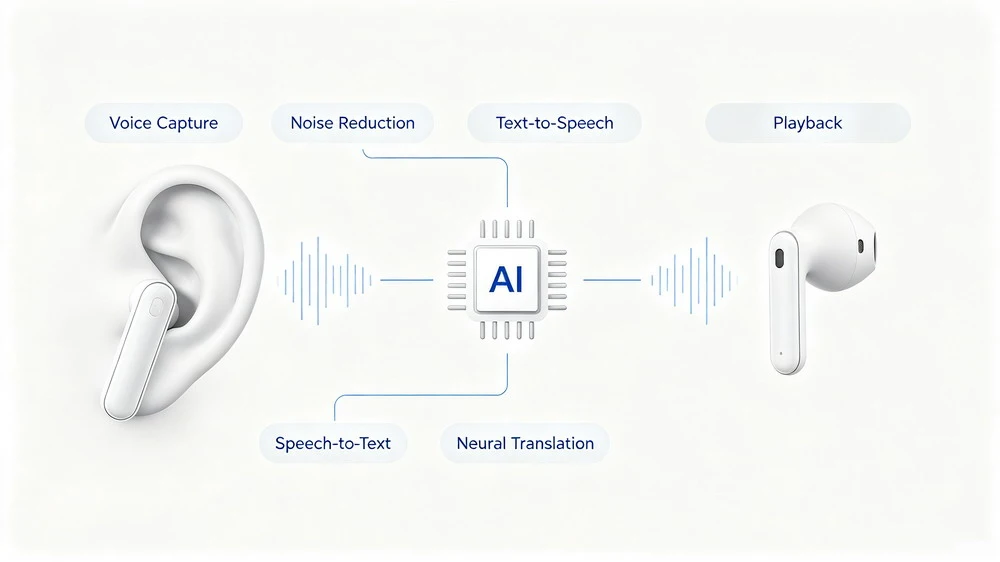
Every AI translation earbud on the market, regardless of brand, runs the same three-stage pipeline. The differences between a $30 product and a $150 product almost always come down to how well each stage is executed, not whether the stage exists.
Stage 1: Speech Capture and Noise Isolation
A dual-microphone array in the earbud captures the speaker’s voice and converts it into a digital audio signal. This is the same hardware job a standard ENC (Environmental Noise Cancellation) earbud does for phone calls — isolating a voice from background noise — but translation earbuds depend on it more heavily, because a speech recognition engine that receives noisy input produces bad transcriptions, and a bad transcription produces a translation that has nothing to do with what was actually said.
Stage 2: Speech Recognition and Machine Translation
The digital audio is passed, usually through the companion app, to an Automatic Speech Recognition (ASR) engine that converts speech into text. That text is then run through a machine translation model that maps meaning from the source language to the target language, rather than translating word for word. This is where accuracy differences between brands show up most: models trained on larger, more diverse multilingual datasets handle accents, idioms, and interrupted sentences noticeably better than smaller offline models.
Stage 3: Text-to-Speech Playback
The translated text is converted back into spoken audio by a text-to-speech (TTS) engine and played through the listener’s earbud, typically within one to two seconds on a good connection. Some products display a live transcript on the phone screen at the same time, which lets both parties confirm the translation is accurate — a useful feature for business negotiation use cases where a mistranslated number or term has real consequences.
What’s Inside AI Translation Earbuds: Hardware and Software Requirements
Chipset and Connectivity
Because the earbud’s job is capturing clean audio and streaming it with minimal delay, the chipset priorities differ from a music-focused TWS product. Buyers should be looking for:
Bluetooth 5.3 or 5.4 for lower latency and more stable dual-device pairing, since some translation modes route audio to two paired phones at once.
Dual or triple microphone arrays with beamforming, so the mic favors the speaker’s voice over ambient noise.
A chipset platform with a solid Bluetooth audio SDK (Qualcomm QCC, Airoha, or BES/Bestechnic are the common choices in this category) that the app developer can build a stable low-latency audio stream on top of.
The chipset handles the audio path — capture, streaming, playback. It’s the app and, for online modes, the cloud backend behind it that carry the actual translation logic.
Online vs. Offline Translation Modes
This is one of the most consequential product decisions, and it’s a common area where marketing claims outrun the actual hardware.
| Online (Cloud) Translation | Offline (On-Device) Translation | |
|---|---|---|
| Language coverage | Broad — often 40 to 140+ languages | Limited to a handful of major language pairs |
| Internet required | Yes | No |
| Accuracy | Generally higher, especially on idioms and accents | Lower, especially on technical vocabulary |
| Updates | Improves without a firmware push | Requires a model update pushed to the app |
| Cost structure | Per-call or subscription API cost | One-time model download, no ongoing API fee |
| Best fit | Business use, daily conversation | Travel, industrial sites, areas with poor signal |
Most competitive AI translation earbuds now advertise a hybrid approach: online translation as the default with a smaller offline model as a fallback for a handful of major language pairs.
What Makes AI Translation Earbuds Different From Regular TWS Earbuds
It’s worth being direct with any customer who assumes this is a simple SKU variation: an AI translation earbud is not a standard TWS earbud with a different app. The differences that matter for sourcing and cost are:
App and backend ownership. The app and cloud backend, not the earbud mold, carry most of the ongoing cost (translation API fees, server hosting) and most of your long-term brand differentiation — that’s where your margin and your customization options actually live.
Microphone specification. Translation accuracy is a direct function of mic quality and beamforming tuning, which means more rigorous mic selection and acoustic testing than a typical earbud program.
Latency tuning. A translation earbud that lags three or four seconds behind natural conversation feels broken even if the translation itself is accurate; Bluetooth audio latency has to be actively tuned, not just left at chipset defaults.
Language and accuracy claims are testable. “144 languages supported” or “96% accuracy” are specific, checkable claims. A buyer should ask a supplier to demonstrate these live, in a real conversation with background noise, before accepting them at face value.
Common Use Cases for AI Translation Earbuds in 2026
The travel use case is still what most people picture, but it’s no longer the primary driver of demand for this category. The buyers we talk to are sourcing AI translation earbuds for:
International trade and factory floor communication — mixed-language manufacturing teams and supplier visits where real-time communication affects safety and quality control, not just convenience.
Business negotiation and sales calls — brand owners and trading companies using translation earbuds in client meetings where a live transcript doubles as a record of what was agreed.
Healthcare and public services — clinics and government offices serving multilingual populations, where accuracy and consistent uptime matter more than the lowest price point.
Education — lecture and classroom translation for international student populations.

What to Check Before Sourcing AI Translation Earbuds
If you’re an Amazon seller, brand owner, or trading company evaluating this category, the earbud hardware is actually the easier half of the decision. Before committing to a supplier, confirm:
Who owns the translation engine. Is the factory licensing a third-party translation API (with an ongoing per-use cost passed to you or your customer), or do they have their own app and backend? This affects your long-term cost structure and your ability to customize the brand experience.
Real language count vs. marketed language count. Ask for the actual supported-language list broken down by offline vs. online-only, not just the headline number.
Certification coverage. Standard FCC and CE/RoHS certification still applies to the hardware, the same as any Bluetooth earbud, regardless of the AI features layered on top.
Sample testing under real noise conditions, not a quiet showroom demo. This is the single fastest way to separate a genuinely well-tuned product from one that only performs well in ideal conditions.
App maintenance and data handling. Since a companion app is core to the product, ask who maintains it after launch and how conversation audio is handled, particularly for business or healthcare buyers with confidentiality requirements.
We build AI translation earbuds on Bluetooth 5.4 platforms out of our Dongguan facility. Our guide to OEM wireless earbuds and private label translation earbuds covers the OEM side of this decision in more depth, including what’s realistic to customize versus what stays fixed on a shared platform.
If you’re comparing this category against other smart-earbud lines, our posts on ANC vs. ENC earbuds and Bluetooth 5.4 in earbuds walk through the same kind of hardware trade-offs from a factory perspective.
At Tashells Audio, we build TWS platforms in Dongguan for brand owners and Amazon sellers who need a partner that can speak plainly about what’s achievable on a given chipset and budget — including where a translation feature genuinely earns its place on a spec sheet, and where it’s better left off.
FAQ
Do AI translation earbuds work without an internet connection? Some do, but with real limits. Offline mode relies on a compressed language model stored on the phone or earbud, which typically covers fewer language pairs and performs less accurately than the online mode. Most competitive products treat offline as a fallback rather than the primary mode.
How many languages do AI translation earbuds actually support? Marketed numbers often reach 40 to 144+ languages, but that figure usually describes total online coverage, not offline support. Always ask a supplier for the offline vs. online-only breakdown before quoting that number to your own customers.
Are AI translation earbuds accurate enough for business use? Accuracy depends heavily on microphone quality, background noise, and the translation engine behind the app — not just the earbud hardware. Top-performing products report accuracy in the mid-90% range for clear, complete sentences in supported languages, but accuracy drops with heavy accents, technical jargon, or overlapping speech.
What’s the difference between AI translation earbuds and a translation app on my phone? The core translation engine can be similar or identical, but earbuds free both hands and both ears, capture audio through a purpose-tuned microphone array instead of a phone mic, and let both parties in a conversation hear translated audio directly rather than passing a phone back and forth.
Can AI translation earbuds be produced as a private-label or OEM product? Yes. Several factories offer OEM/ODM programs for this category, covering shell design, packaging, and branding on top of an existing hardware and app platform. The translation engine itself is usually licensed rather than built from scratch, so ask early in the sourcing process whether the app and backend are included in your agreement or billed separately.