Battery Testing for TWS Earbuds: What Actually Gets Measured Before a Batch Ships
“6 hours playback, 24 hours with the case.” Every TWS earbuds spec sheet has a line like this, and almost none of them tell you how that number was produced. Was it measured at 50% volume with the screen off, or at a realistic listening level with calls mixed in? Was it measured once, on a hand-built sample, or averaged across a production batch after 300 charge cycles?
That gap, between a number on a spec sheet and a number your customers actually experience, is what battery testing is supposed to close. This guide walks through what real battery testing for TWS earbuds looks like: what gets measured, which standards apply, and what to ask a factory before you commit to an order.
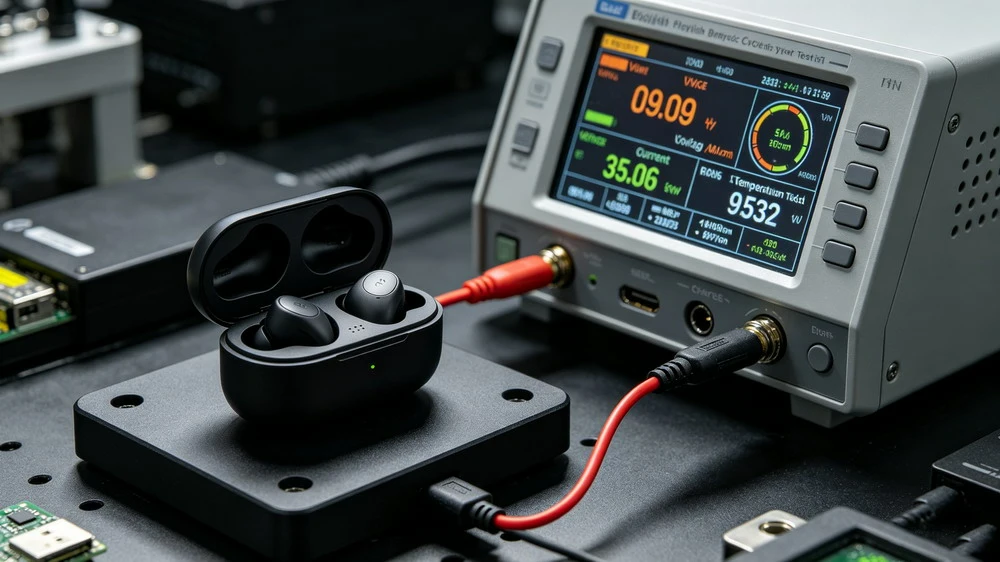
Why Battery Testing Matters More Than the Datasheet Number
Battery complaints rarely show up in week one. A new pair of earbuds almost always performs close to spec when it’s fresh out of the box — the cell is new, the firmware hasn’t drifted, and the customer hasn’t stress-tested it yet. The problems surface three to six months later: playback time quietly drops, the case stops holding a full charge, or one earbud dies faster than the other. By then the return window has usually closed, but the review is still live.
For an Amazon seller or brand owner, that timing is the whole risk. A battery issue doesn’t cost you a single refund. It costs you a 2-star review sitting on your listing for the next two years. Testing exists to catch that failure mode before it ships, not after a customer writes about it.
Datasheets describe what a cell is rated to do under lab conditions. Testing tells you what the finished product actually does — soldered onto your PCB, running your firmware, inside your specific shell, at the volume level your customers actually use.
The Two Battery Types Behind Most TWS Products
Before testing methodology makes sense, it helps to know what’s actually inside the earbud, because the two common formats behave differently under stress.
Coin Cell vs. Micro Pouch Cell
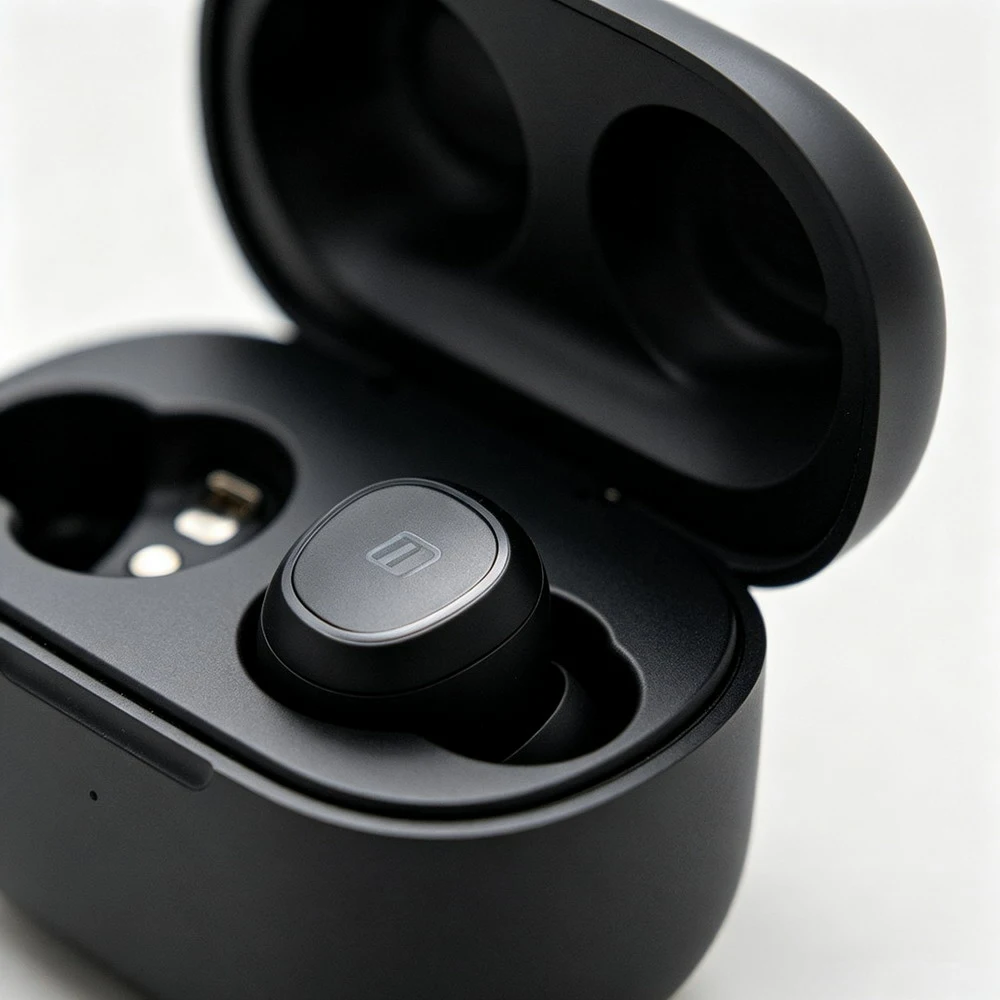
Earlier TWS designs largely used small lithium coin cells — simple, cheap, and easy to source, but limited in capacity for their size. Most current mid-to-premium earbuds have shifted to micro pouch cells, thin flexible lithium-polymer cells wrapped in aluminum laminate film, which pack more capacity into the same tiny cavity. Pouch cells are also more sensitive to manufacturing quality: a poorly sealed laminate edge is a slow failure waiting to happen, which is exactly why cycle life and swelling checks matter more on pouch-cell designs than on coin cells.
Neither format is inherently “better” — the right choice depends on target playback time, shell size, and price tier. What matters for a buyer is knowing which one is going into your product, because it changes what you should be asking your supplier to test for.
What Battery Testing Actually Covers
“Battery testing” isn’t one test. It’s a set of separate checks, each catching a different failure mode.
Capacity and Real-World Playback Verification
This is the test that validates (or contradicts) the number on your product listing. A charged unit plays audio continuously at a realistic listening volume until the battery depletes. Testing at the lowest volume setting is a common shortcut that artificially stretches the result, so the recorded time only means something if the volume level is disclosed alongside it. If a listing promises 6 hours and testing lands at 4, that’s not a rounding error; it’s a batch that shouldn’t ship with that claim still on the box.
Cycle Life Testing
Cycle life testing charges and discharges the cell repeatedly under controlled conditions to see how many full cycles it can complete before capacity drops below a set threshold — commonly 80% of the original rated capacity. This is the test that predicts what a customer’s earbuds will feel like six months in, not on day one. A cell that holds up well for the first 50 cycles but falls off a cliff by cycle 150 will look completely fine in a sample review and still generate a wave of “battery died fast” complaints a couple of months after launch.
Internal Resistance (DCIR) and Voltage Sag
Internal resistance, usually measured as DCIR, determines how well a cell holds voltage under a sudden current draw — the kind of spike that happens when ANC, a Bluetooth radio burst, and audio playback all draw power at once. High internal resistance shows up to the end user as voltage sag: a brief dropout, a crackle, or a sudden volume dip during heavier processing loads. This matters more on ANC-enabled earbuds than on basic playback-only models, since ANC processing adds a real, continuous current draw the cell has to support.
Charging Case Testing
The case gets tested separately from the earbuds themselves, and buyers often skip this step entirely. Testing here covers how many full earbud recharges the case can actually deliver before it needs its own recharge, how long the case itself takes to reach full charge, and whether the charging contacts maintain consistent connection across repeated open-close cycles. A case rated for “4 additional charges” that only delivers 2.5 in practice is a common, quietly under-tested failure point.
Safety Certification: UN38.3 vs. IEC 62133
These two standards get mentioned together constantly and confused just as often. They’re not interchangeable, and a factory that can only produce one of them hasn’t actually covered your compliance risk.
| UN38.3 | IEC 62133-2 | |
|---|---|---|
| Covers | Transport safety for shipping lithium cells by air/sea | Electrical and mechanical safety of the cell itself |
| Answers the question | Can this battery legally be shipped? | Is this battery safe to use in a product? |
| Typical tests | Altitude, thermal, vibration, shock, short-circuit | Overcharge protection, crush resistance, thermal abuse |
| Required for | Every international shipment by air | Product safety compliance in most target markets |
A factory should be able to produce both, matched to the exact cell model and batch date going into your order — not a generic certificate reused across a dozen unrelated SKUs in their catalog. If a supplier can only hand you one of the two, ask directly which one is missing and why.
Where Battery Testing Fits in the Production Timeline
Battery testing isn’t a single event at the end of the line. It happens at more than one stage, and skipping a stage leaves an entire category of defect invisible until the units are already packed.
Incoming cells get checked against spec before assembly (IQC), a sample gets pulled mid-run to catch a component or firmware swap before it spreads across the whole batch (DUPRO), and the finished, packed goods get sampled again before release (PSI).
The mid-run check matters more than buyers usually assume. A cell supplier swap between run one and run two of the same order is common, and it rarely shows up until someone pulls units off the line and runs them through a fresh cycle test. We cover the full IQC/DUPRO/PSI process, including AQL sampling levels, in our earbuds quality testing guide, so this article stays focused on the battery-specific tests themselves rather than repeating that framework.
Red Flags in a Supplier’s Battery Test Claims
A few patterns are worth watching for before you wire a deposit:
The only battery data offered is the number printed on the product listing, with no test report behind it.
Certification documents don’t reference your specific model number or a matching batch date.
Playback time claims can’t be explained in terms of volume level or test conditions when you ask directly.
Cycle life is never mentioned unless you bring it up first, and even then the answer is vague.
No willingness to run or share a cycle test on a pre-production sample batch before scaling to full volume.
None of these alone is automatically disqualifying, but two or more together are worth taking seriously before you commit.
How Tashells Audio Tests Battery Performance
At Tashells Audio, battery testing runs alongside acoustic and RF testing rather than as an afterthought tacked onto final inspection. Cells are checked at IQC against the incoming spec, cycle-tested against an 80%-capacity threshold, and validated for real-world playback with the volume level documented alongside the result. UN38.3 and IEC 62133 documentation is prepared per model and per batch, matched to the actual cell going into your production run.
For buyers building out a private label earbuds line or sourcing through our OEM earbuds manufacturer service, our team can walk through the cycle life and playback data for the specific chipset and battery combination you’re considering before you commit to a deposit. General battery-life expectations by product category are covered in our TWS earbuds battery life guide, if you’re still deciding on a target spec before testing begins.
Conclusion: Ask for the Test Data, Not Just the Spec
A battery spec sheet is a claim. Cycle life data, DCIR measurements, and matched UN38.3/IEC 62133 reports are proof. The difference matters most for the customer who’s still using your earbuds four months after purchase, past the return window, deciding whether to leave a review.
Ready to see battery test data for your specific earbuds project? Request a Quote or ask our team for cycle life and playback reports on the chipset and battery combination you’re evaluating.
FAQ
What is the most reliable way to verify a TWS earbuds battery life claim? Request the actual playback test report, including the volume level and test conditions used — not just the number printed on the listing. A 6-hour claim tested at minimum volume isn’t comparable to one tested at a realistic listening level.
What’s the difference between UN38.3 and IEC 62133 for earbuds batteries? UN38.3 covers the safety of shipping lithium cells by air and sea. IEC 62133 covers the electrical and mechanical safety of the cell itself — overcharge, short-circuit, and thermal abuse behavior. A supplier needs both, matched to the specific cell and batch.
How many charge cycles should a TWS earbuds battery last before performance drops? Most lithium-polymer cells used in earbuds are rated to retain around 80% of original capacity after several hundred charge cycles, though the exact number depends on the cell chemistry and how conservatively the charging circuit manages voltage. Ask your supplier for the cycle life test data rather than assuming a generic figure applies to your specific cell.
Does ANC affect battery testing results? Yes. ANC processing adds a continuous current draw that isn’t present in basic playback-only testing, which is why internal resistance (DCIR) and real-world playback testing matter more for ANC-enabled models — a cell that performs fine under simple playback can still show voltage sag once ANC processing is added to the load.
Is the charging case tested separately from the earbuds? It should be. Case testing covers how many full earbud recharges the case delivers before it needs recharging itself, how long the case takes to reach full charge, and whether the charging contacts stay reliable across repeated open-close cycles — none of which the earbud-only playback test captures.
Should I test battery performance on a sample or a full production batch? Both, but they answer different questions. A sample shows you the product’s potential; a small pre-production batch (commonly 50–100 units) run through cycle and playback testing shows you what actual production consistency looks like before you commit to full volume.