How Long Should TWS Earbuds Battery Last?
If you’ve spent any time comparing wireless earbuds — as a buyer or as someone sourcing a new SKU — you’ve run into the same problem: every listing shouts “30 hours of battery life!” and none of them agree on what that number actually means.
That’s the real question hiding behind “how long should TWS earbuds battery last?” It’s not one number. It’s at least three: how long they play on a single charge, how much extra playtime the case adds, and how long that performance holds up before the battery starts to fade. Most buying mistakes — and most 1-star reviews about “battery died in a year” — come from looking at only one of those three numbers and ignoring the other two.
This guide breaks down realistic benchmarks for each, what actually drains a battery day to day, and how to verify a supplier’s claims before you commit to a bulk order.
What “Battery Life” Actually Means for TWS Earbuds
Marketing copy tends to blur two very different specs into one headline number. It’s worth separating them before you compare anything else.
Single-charge playback is how long the earbuds themselves run before you have to put them back in the case — this is the number that determines whether they’ll survive a flight, a workout, or a full workday of calls.
Total battery life with the case is single-charge playback multiplied by however many extra full charges the case holds. A case rated for “3 additional charges” on top of a 6-hour bud is where you get to a “24-hour” marketing claim — but you’re still only getting 6 hours before you need to dock them.
Then there’s a third figure almost nobody puts on the box: cycle life, or how many charge cycles the battery can handle before its capacity starts dropping. That one determines how the product performs a year from now, not on day one.
For sourcing decisions, all three matter. A SKU that lists “28 hours total” but only 4 hours single-charge and a 200-cycle battery will generate more returns and support tickets than one with a more modest 22-hour total and a 6-hour single charge on a better cell.
Realistic Battery Life Benchmarks by Product Tier
Based on what we see across production runs and what’s typical in the current TWS earbuds market, here’s a realistic range by tier — treat any claim well outside these ranges as one to verify before you trust it.
| Tier | Single Charge | Total with Case | Typical Earbud Cell |
|---|---|---|---|
| Budget | 3–4 hours | 12–20 hours | ~25–35mAh |
| Mid-range | 4–6 hours | 20–30 hours | ~40–55mAh |
| Premium / Flagship | 6–10 hours | 30–40+ hours | 55–70mAh |
Budget tiers cut corners on cell capacity first because it’s the cheapest way to hit a low price point. This is also where inconsistent battery levels between the left and right bud show up most — a sign of loose quality control rather than a design flaw.
Mid-range earbuds are where most Amazon private-label and general wholesale demand sits. It’s also, in our experience, the sweet spot for cost-to-performance — enough runtime for a full workday plus commute, without pushing unit cost into premium territory.
Premium/flagship earbuds get their runtime from a combination of larger cells, a more power-efficient Bluetooth chipset, and tighter firmware power management — not from any single trick.
What Actually Drains (or Saves) Battery Life
Two products with identical mAh ratings on the spec sheet can still deliver noticeably different real-world runtime. Capacity is only the ceiling — what happens above that ceiling depends on these factors.
Battery Capacity and Cell Quality
Larger cells hold more charge, but cell quality determines how much of that capacity survives repeated charging. Premium coin-cell or pouch-cell batteries from reputable cell manufacturers hold their capacity longer than off-brand cells bought purely on price. This is one of the least visible differences between suppliers and one of the most consequential for return rates six months after launch.
ANC and ENC Power Draw
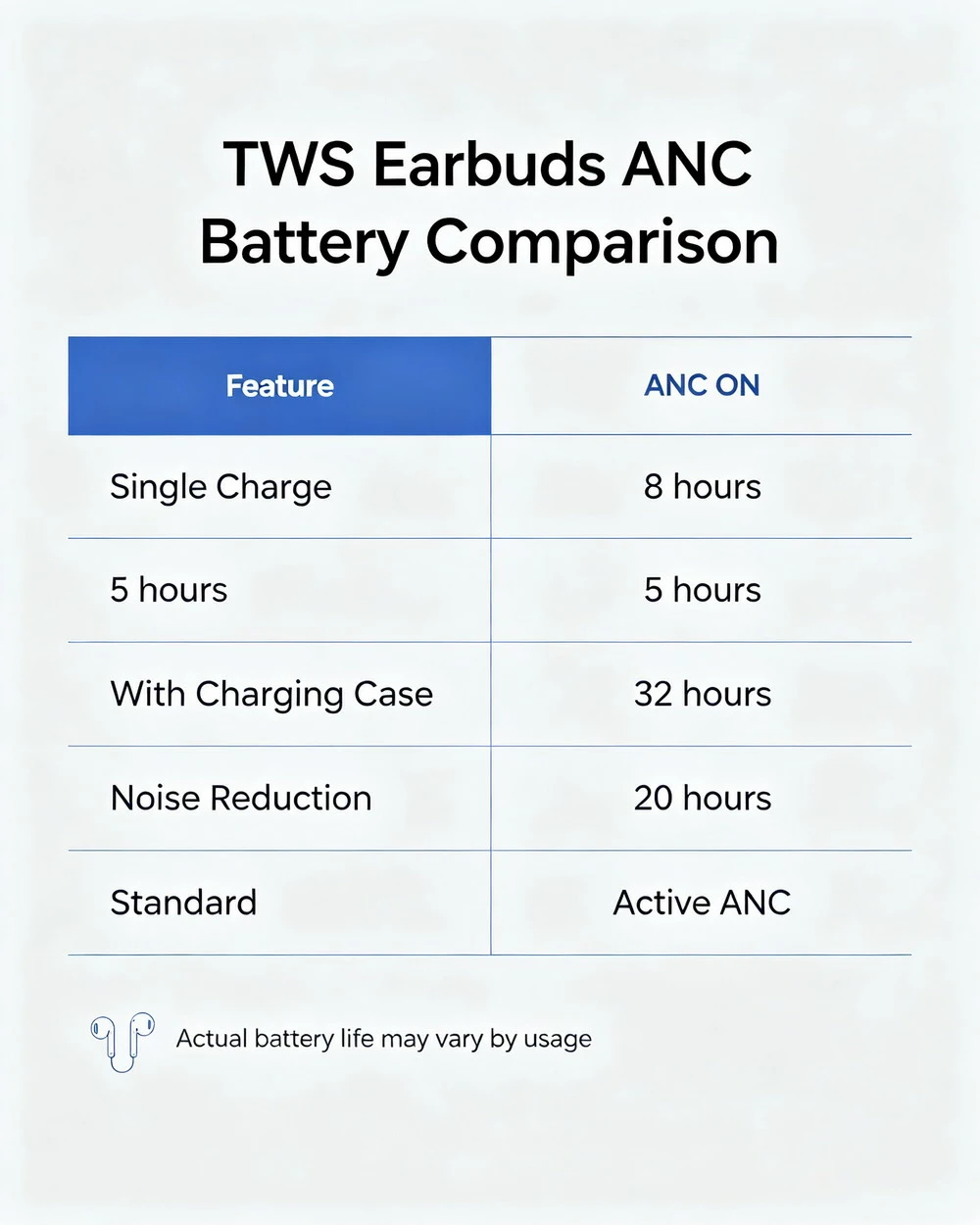
Active Noise Cancellation runs continuous processing to generate the cancellation signal, and that processing has a real power cost — typically a 20–40% reduction in single-charge runtime compared to ANC off. Environmental Noise Cancellation (ENC), used for call clarity rather than music listening, draws less power than ANC but still more than a basic mic setup. If a product page advertises ANC and a headline battery number without specifying ANC on/off, that’s a gap worth closing before you spec the SKU.
Bluetooth Chipset and Codec Efficiency
The chipset platform has more influence on power efficiency than most buyers realize. Qualcomm QCC, Airoha, BES (Bestechnic), and Jieli solutions all handle power management differently, and newer Bluetooth 5.3/5.4 implementations are generally more efficient than older 5.0/5.1 designs on the same cell size.
Codec choice matters too. SBC and AAC are relatively power-light. aptX and especially LDAC push more data over the Bluetooth link for higher audio fidelity, which means more radio activity and shorter runtime at a given volume — a trade-off worth flagging to buyers who care about hi-res audio marketing claims.
Volume, Calls, and Firmware
Higher volume draws more current from the amplifier, and calls draw more than music playback because the microphone array and, on ENC-equipped models, the noise-processing chain stay active continuously. Firmware also plays a quiet but real role — well-tuned power management (sleep states between taps, efficient in-ear detection) can add meaningful runtime without touching the hardware at all.
Battery Life vs. Battery Lifespan: The Number Buyers Forget
Single-charge runtime tells you how the product performs on day one. It says nothing about month twelve.
Lithium batteries degrade with every charge cycle, and most earbud-grade cells are rated for 300–500 full charge cycles before capacity noticeably drops — roughly 2–3 years of normal daily use. After that point, users typically notice shorter playback time, faster drain when idle, and eventually one bud dying well before the other.
This is the spec most listings never mention, and it’s the one that drives long-tail warranty claims and negative reviews far more than the headline runtime number does. If you’re sourcing, ask your supplier directly for cycle-life data — not just single-charge and case-total numbers.
Signs of Poor Battery Quality
Whether you’re evaluating a sample from a new supplier or troubleshooting complaints on an existing SKU, these are the patterns our quality control process is built to catch early:
Rapid drain that doesn’t match the rated single-charge time
Uneven battery percentage between the left and right earbud
Slow or inconsistent charging speed
The case or buds running noticeably warm during charging
Buds losing charge while sitting idle in the case
Any one of these on a sample batch is usually a sign of a weaker cell, a poorly matched charging IC, or inconsistent quality control on the production line — not something firmware can fully fix later.
How to Test Battery Performance Before You Place a Bulk Order
This is the step most first-time buyers skip, and it’s the one that prevents the most expensive mistakes. Before committing to an order quantity, run the sample pair through a basic four-part test:
1. Playback Drain Test
Fully charge the earbuds, then play continuous audio at a moderate, consistent volume until they shut off. Compare the result — with ANC on and off separately — against what the supplier claims.
2. Charging Speed Test
Time a full charge from empty, and separately test any advertised fast-charge claim (for example, “10 minutes for 1–2 hours of playback”). Inconsistent fast-charge performance is a common gap between spec sheet and reality.
3. Case Recharge Capacity Test
Drain the buds fully, recharge from the case, and repeat until the case itself is empty. This confirms the “total hours with case” figure rather than taking it on faith.
4. Standby Drain Test
Leave the buds fully charged and idle — outside the case — for 24–48 hours, then check how much charge was lost. Excessive standby drain usually points to a firmware or power-management issue that won’t show up in a short demo.
Run this on samples before scaling to a bulk order. It’s a few days of testing that can save months of returns.
Choosing the Right Battery Spec for Your Market
Battery life isn’t a “bigger is always better” spec — it’s a fit question tied to how your end customer will actually use the product.
Commuters and office users: mid-range specs (4–6 hours single charge, 20–30 hours total) comfortably cover a workday plus travel time.
Sports and gym-focused SKUs: prioritize single-charge runtime over total case capacity — a workout doesn’t pause for a charging dock.
Business/call-center use cases: prioritize ENC-related power efficiency, since call time drains faster than music playback.
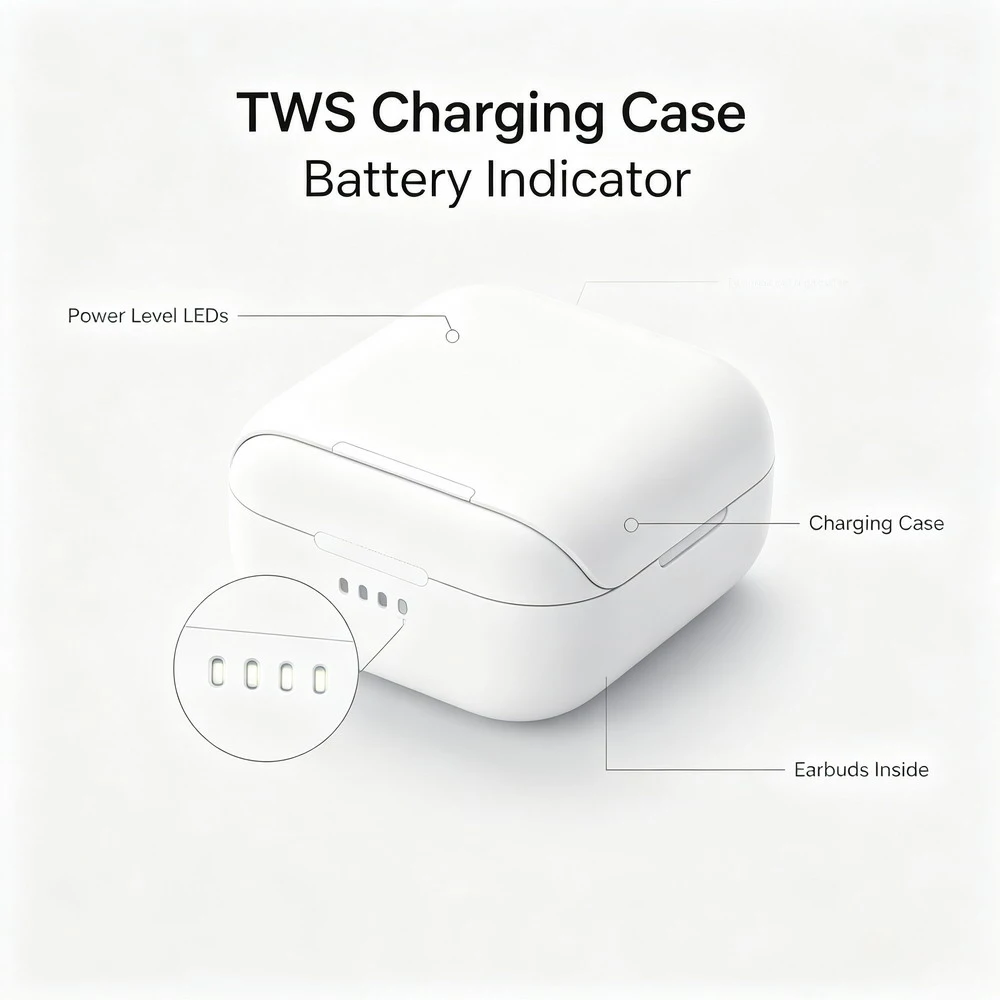
Gift and lifestyle-market SKUs: total battery life and a visible case indicator often matter more to the buying decision than raw hours, since these buyers rarely push the product to its limits.
For most general-market Amazon and wholesale demand, the mid-range tier — roughly 4–6 hours single charge and 20–30 hours with the case — remains the best balance of cost, customer satisfaction, and return-rate performance. Going premium only pays off when your positioning and price point can support it.
Why Battery Quality Varies So Much Between Suppliers
Two SKUs can share the same on-paper mAh rating and still perform completely differently once they’re in customers’ hands. The difference usually comes down to three things a spec sheet doesn’t show: the actual cell manufacturer behind the battery, how well the charging circuit is matched to that cell, and how much cycle-life and burn-in testing happens before the product ships. This is also where the three numbers from the top of this guide start to diverge between suppliers — identical spec-sheet claims, very different real-world single-charge and cycle-life results.
At Tashells Audio, this is one of the areas we get the most sourcing questions about, because it’s also where the most corner-cutting happens industry-wide. Our production runs use cells from established manufacturers rather than the cheapest available lot, and every batch goes through discharge, charging-speed, and standby testing before it leaves the factory floor — not just a spot-check on a handful of units.
For brand owners and Amazon sellers who’ve been burned by inconsistent battery performance from a previous supplier, that testing step tends to matter more than a marginally higher mAh number on a spec sheet.
One More Check Before You Sign Off on an Order: Certifications
Battery testing tells you how the product performs. Certifications tell you whether the supplier’s manufacturing process is disciplined enough to keep performing that way batch after batch. For earbuds specifically, that means FCC, CE, and RoHS on the finished product, BQB for the Bluetooth radio, and — often overlooked — UN38.3 for the lithium battery itself, which covers the safety testing required to legally ship batteries by air and sea.
A supplier who can’t produce current UN38.3 test reports on request is a red flag worth taking seriously, regardless of how good their sample battery life numbers look.
FAQ: TWS Earbuds Battery Life
How long should TWS earbuds last on a single charge? For most mid-range products, 4–6 hours of continuous playback is a realistic, reliable benchmark. Budget models often run 3–4 hours, while premium models with larger cells and efficient chipsets can reach 6–10 hours.
How long should a TWS earbuds battery last with the charging case? Total playtime including case recharges typically ranges from 12–20 hours for budget models up to 30–40+ hours for premium models, depending on how many additional full charges the case holds.
How many years should a pair of TWS earbuds’ battery last? Most quality earbud batteries are rated for 300–500 charge cycles, which works out to roughly 2–3 years of normal daily use before capacity noticeably declines.
Does ANC really reduce battery life that much? Yes — Active Noise Cancellation typically reduces single-charge runtime by 20–40% compared to ANC off, since the feature requires continuous signal processing.
Why do cheap earbuds often have worse battery life? Lower-cost products tend to use smaller or lower-grade battery cells, less efficient charging components, and weaker power management, which shows up as shorter runtime, uneven battery levels between buds, and faster degradation over time.
How can I test earbuds battery performance before placing a bulk order? Run a continuous playback drain test (with ANC on and off), a full charging-speed test, a case recharge-capacity test, and a 24–48 hour standby drain test on samples before committing to volume — this exposes gaps between claimed and actual specs early.
Final Thoughts
“How long should TWS earbuds battery last?” doesn’t have a single right answer — but a well-specified product should reasonably deliver:
4–6 hours of single-charge playback for general-market use
20–30 hours of total playtime with the charging case
300–500 charge cycles, or roughly 2–3 years of reliable performance
If you’re building or scaling an earbuds brand, the number on the box matters less than whether a supplier can back it up with real testing data and consistent cell quality across production batches. That consistency — not a slightly higher advertised hour count — is what actually protects your return rate and your reviews.
Ready to spec a battery configuration that fits your market and get real test data on a sample run? Request a quote or reach out for a sample from Tashells Audio’s current TWS earbuds lineup.