What Are Open Ear Earbuds?
Open ear earbuds are wireless earphones that rest on or around the outer ear instead of plugging into the ear canal, so the wearer hears their audio and their surroundings at the same time. If you’ve spent any time browsing Amazon’s headphone category lately, you’ve probably noticed the shape: earbuds that hook over the ear and hover near it rather than sealing it shut. That’s become one of the fastest-moving product lines in the TWS space.
I get asked about this category almost every week — usually by sellers who’ve seen the search volume climb and want to know if it’s worth adding to their catalog, or by brand owners trying to figure out what separates a “real” open ear earbud from a re-labeled sports earbud with a hook glued on. So let’s start with how they actually produce sound without sealing the ear canal, and what you need to check before you put your name on a batch of them.

How the Design Differs From Regular Earbuds
There’s no silicone tip on these earbuds, no seal, and no pressure buildup. The ear canal stays completely open to outside sound while a small speaker positioned just outside it handles playback.
This is different from what most people picture when they hear “earbuds.” Traditional TWS earbuds and ANC earbuds use ear tips that plug the canal to isolate sound. Open ear designs do the opposite on purpose — that’s why the category is sometimes called “ear-free” or “canal-free” audio.
You’ll usually see open ear earbuds in one of two physical formats:
Ear-hook style — a flexible hook wraps around the top of the ear and holds a small acoustic unit near the ear opening. This is the more common format for sport-oriented SKUs.
Clip-on style — a clip pinches gently around the earlobe or the ear’s outer ridge, with no hook over the top. This format tends to appeal to buyers who don’t want anything resting on their hairline, and it overlaps with what we cover in our clip-on earbuds sourcing guide.
Both formats rely on the same underlying principle: keep the canal open, aim the sound at it from close range, and let physics do the rest.
How Open Ear Earbuds Actually Produce Sound
This is the part that trips people up, including some sellers who list the product without fully understanding it. If nothing is sealing your ear, how do you hear anything clearly, and how does the person next to you not hear it too?
Air Conduction: The Dominant Technology
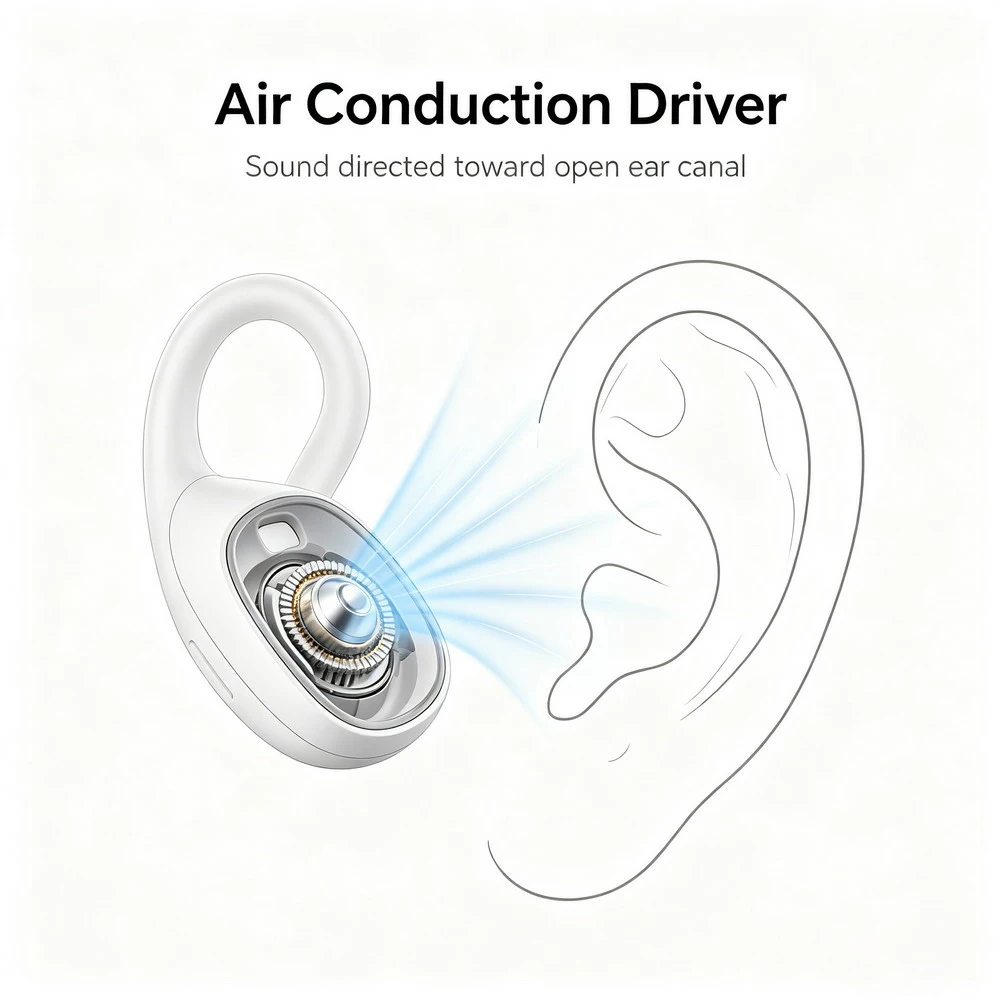
The overwhelming majority of what’s sold today as “open ear earbuds” uses air conduction. A small dynamic driver, typically in the 13–16mm range, sits a few millimeters from the ear canal opening and fires sound directly into it using a directional acoustic chamber. The eardrum vibrates the same way it would with any conventional headphone — the sound just arrives from outside the canal instead of from inside a sealed tip.
To keep the sound from leaking out to bystanders, factories tune the acoustic chamber and driver angle to concentrate the sound wave toward the ear canal and let it disperse quickly once it passes the ear. This is sometimes marketed as “directional sound” or “audio beamforming,” though in practice it’s mostly a mechanical and acoustic tuning problem rather than true digital beamforming.
Get the tuning wrong and you end up with a product that leaks audio at anything above 60% volume — a very common complaint in reviews of budget models, and a common reason batches fail buyer QC.
Bone Conduction: A Related but Distinct Category
Bone conduction is often lumped into the same conversation, and it’s worth being precise about the difference because buyers frequently confuse the two. Bone conduction earbuds sit on the cheekbone in front of the ear and send vibrations through the skull bone directly to the inner ear, bypassing the eardrum entirely. There’s no driver aimed at the ear canal at all.
Air conduction (true open ear) generally delivers noticeably better bass response and a more natural, full-bodied sound because it’s using the ear’s normal hearing mechanism. Bone conduction trades some audio richness for an even more secure, canal-free fit and is popular with users who have certain ear sensitivities or who need maximum situational awareness in high-risk environments like urban cycling.
If a customer or a marketplace listing says “open ear” without specifying, assume air conduction — that’s what the term defaults to in sourcing conversations and in current search demand. If you’re buying bone conduction, it’s better practice to label it that way rather than folding it into an “open ear” listing, since the two technologies solve different problems and buyers are starting to search for them separately.
Sound Privacy at Normal Volumes
A fair question from buyers: does everyone around you hear the audio too? At moderate volume (roughly 50–70% of max) with a well-tuned acoustic chamber, sound leakage is minimal in quiet environments and largely masked in normal ambient noise like an office or street. Push the volume past that, or use a poorly tuned driver housing, and leakage becomes noticeable within a meter or two.
This is one of the acoustic specs worth requesting test data on before you commit to a supplier, especially for private label programs where customer reviews will call it out immediately if it’s off.
Open Ear vs. In-Ear vs. ANC Earbuds
For a buyer deciding what to stock, the comparison usually comes down to these three categories.
| Feature | Open Ear (Air Conduction) | Standard In-Ear TWS | ANC In-Ear |
|---|---|---|---|
| Ear canal | Fully open | Sealed with tip | Sealed with tip |
| Environmental awareness | High | Low | Very low (by design) |
| Bass response | Moderate | Strong | Strong |
| Comfort for long wear | High, no canal pressure | Moderate | Moderate |
| Best use case | Running, cycling, office, calls | General daily use, music focus | Travel, commuting, noisy environments |
| Sound leakage risk | Present at high volume | Minimal | Minimal |
| Typical retail price band | Mid to upper-mid | Entry to mid | Mid to premium |
Neither category is objectively “better” — they solve different listening problems. What matters for sourcing decisions is that open ear buyers are shopping with a specific need in mind (usually safety or comfort during activity), which tends to make this category less price-sensitive and more feature-sensitive than generic TWS earbuds. That’s relevant if you’re deciding where to spend your differentiation budget.
What’s Actually Inside an Open Ear Earbud
If you’re sourcing rather than just reselling, the internals matter more than the marketing copy. Here’s what to look at.
Chipset Platform
Most models on the market today run on Qualcomm QCC series, Airoha, BES (Bestechnic), or Jieli platforms. Qualcomm and Airoha chipsets tend to support better codec options and more stable multipoint connection, which matters for buyers targeting the office/call-center use case. Jieli-based solutions are common in lower-cost public mold builds and can be perfectly adequate for entry-level SKUs, but they typically cap out at SBC/AAC codec support.
If a supplier’s spec sheet doesn’t name the chipset, ask — it’s a five-second question that tells you a lot about where the product sits on the quality spectrum. Bluetooth module certification itself is worth understanding too; the Bluetooth SIG’s qualification listing is the reference source suppliers should be able to point you to when they claim BQB compliance.
Codec Support
SBC is the baseline every Bluetooth earbud supports. AAC improves quality on Apple devices. aptX and LDAC show up on higher-tier open ear models aimed at buyers who care about streaming quality, though the audible benefit is smaller on open ear designs than on sealed earbuds simply because the acoustic path isn’t sealed to begin with. For most open ear SKUs, AAC + SBC is a reasonable baseline; aptX/LDAC support is a legitimate upsell feature for a premium tier.
Driver Size and Housing Design
Driver size alone doesn’t tell the whole story — the acoustic chamber and venting design matter just as much for how directional (and how leak-resistant) the sound ends up being. This is where cheap open mold designs and a properly tuned semi-custom or full-custom build diverge the most. If two suppliers quote the same driver size but wildly different prices, ask to hear a sample before assuming the cheaper one is the better deal.
Battery and Fit Hardware
Because open ear earbuds are worn during activity, battery life and hook/clip durability get tested harder than on a typical sealed earbud. Buyers should ask for cycle-life data on the hook hinge (how many open-close or flex cycles before the hook loses shape) in addition to the standard battery spec sheet.
Who’s Actually Buying Open Ear Earbuds
From a catalog-planning perspective, demand clusters around a few clear use cases: runners and cyclists who need traffic awareness, office workers who take calls all day and don’t want ear fatigue, warehouse and delivery staff who need to hear instructions or forklifts around them, and parents or caregivers who want to stay half-tuned-in to their environment. That’s a meaningfully different buyer than the person shopping for ANC earbuds to block out a flight.
If you’re writing product copy or choosing which features to lead with, safety and all-day comfort will usually outperform “premium sound” as the primary hook. For a side-by-side on how this compares to fully sealed designs, our wholesale Bluetooth earbuds buying guide breaks down the broader TWS category by use case.
Sourcing Open Ear Earbuds: What to Check Before You Commit
This is where a lot of sellers get burned, usually because they treat open ear earbuds like any other TWS SKU and skip category-specific diligence.
Certifications
At minimum, confirm FCC and CE for US/EU market entry, RoHS for materials compliance, and BQB certification for the Bluetooth module itself. If you’re shipping via air or sea in volume, UN38.3 documentation for the lithium battery is non-negotiable — customs holds on undocumented battery shipments are one of the most common (and most avoidable) delays we see. UKCA is worth confirming separately if the UK is a target market, since it isn’t automatically covered by CE.
MOQ and Customization Level
Open mold (public mold) open ear designs typically carry lower MOQs, often in the 300–500 unit range, and let you customize color, packaging, and logo without touching the housing tooling. Semi-custom builds (your own housing on an existing chipset/driver platform) usually start higher, often 1,000–3,000 units, with a 20–35 day sampling window. Full custom development — your own mold, your own acoustic tuning — is a different conversation entirely and usually only makes sense once a public-mold version has proven the SKU sells.
Quality Control Points Specific to This Category
Beyond the standard AQL sampling and IQC/DUPRO checks every TWS order should have, ask specifically about acoustic leakage testing at rated volume and hook/clip stress testing, since these are the two failure points that show up disproportionately in open ear reviews compared to sealed-tip earbuds. A supplier who already has these as standard QC line items, rather than something you have to request, is usually a signal they’ve shipped this category before and know where it breaks.
Shipping Terms
FOB and EXW remain the standard terms for most B2B open ear orders out of South China; CIF is worth requesting if you’re new to importing and want the supplier to handle freight and insurance, though it typically comes at a premium over FOB.
Where Tashells Audio Fits
We build these earbuds out of our Dongguan production facility on both public mold and semi-custom platforms, running Qualcomm, Airoha, and Jieli chipsets depending on the target price tier. If you’re evaluating whether to add this category to your lineup, we can usually get a sample built within two to three weeks on an existing platform, with full FCC/CE/RoHS/BQB documentation and UN38.3 battery paperwork ready for export.
For sellers still deciding between public mold and semi-custom, we’re happy to walk through both options against your target retail price before you commit to a PO — the same tradeoffs we cover in our TWS earbuds wholesale sourcing guide.
FAQ
Are open ear earbuds good for running? Yes — this is the single biggest use case driving the category’s growth. The open canal design lets runners hear traffic, other pedestrians, and their own breathing/footing cues, while the hook or clip format holds the earbud in place better than a sealed tip during high-impact movement.
Can people around me hear my music with open ear earbuds? At moderate volume, sound leakage is minimal and usually masked by ambient noise. It becomes noticeable at higher volumes or with a poorly tuned acoustic chamber, which is why leakage testing at rated volume matters during sourcing.
Are open ear earbuds the same as bone conduction earbuds? No. Open ear (air conduction) earbuds use a small driver aimed at the open ear canal, and the eardrum still does the work of hearing. Bone conduction earbuds sit on the cheekbone and transmit vibrations through the skull, bypassing the eardrum entirely. Both keep the ear canal open, but they’re different technologies with different sound signatures.
Do open ear earbuds have worse sound quality than regular earbuds? They generally have less bass impact than a sealed in-ear design, since there’s no seal to reinforce low frequencies. Mid and high frequencies are typically comparable, and the gap in bass has narrowed considerably as driver and acoustic chamber tuning have improved over the past couple of product generations.
What’s a reasonable MOQ for open ear earbuds? On a public mold platform, 300–500 units is typical. Semi-custom builds with your own housing generally start around 1,000–3,000 units. Full custom tooling requires a separate discussion and is usually reserved for SKUs with proven sales history.
Are open ear earbuds waterproof? Most current models carry an IPX4 to IPX6 rating, enough for sweat and light rain resistance, though because the housing isn’t sealed the way an in-ear earbud can be, very few open ear designs push past IPX6. If waterproofing is a priority for your target use case (e.g., a swimming-adjacent SKU), confirm the exact IP rating and test method with your supplier rather than assuming from marketing copy alone.
Final Word
Open ear earbuds aren’t a gimmick category — they’re solving a real problem for a real (and growing) set of buyers who don’t want to choose between hearing their music and hearing their surroundings. If you’re considering the category, the technology itself is straightforward once you understand the air conduction vs. bone conduction distinction. The harder part is sourcing a version that’s actually been tuned properly, tested for leakage and hook durability, and documented for the markets you’re shipping into.