In-Ear vs Semi-In-Ear Earbuds: A Sourcing Guide for Brands and Amazon Sellers
Every few weeks a buyer sends us the same message: “We want to launch a new earbuds SKU — should it be in-ear or semi-in-ear?” It sounds like a simple design question. It isn’t. The form factor you pick decides which chipset platform you can use, whether ANC is even worth building in, how much your mold will cost, and — most importantly — whether the finished product actually fits the customer you’re selling to.
Most articles comparing these two designs are written for consumers deciding what to buy for themselves. This one is written from the other side of the table: what changes on the factory floor, in the BOM, and in your certification file, depending on which shape you choose.
The short version: in-ear and semi-in-ear are not two flavors of the same product. They’re two different acoustic architectures that serve two different buyer profiles, and picking the wrong one for your target market will cost you more in returns and rewrites than the tooling ever would have.
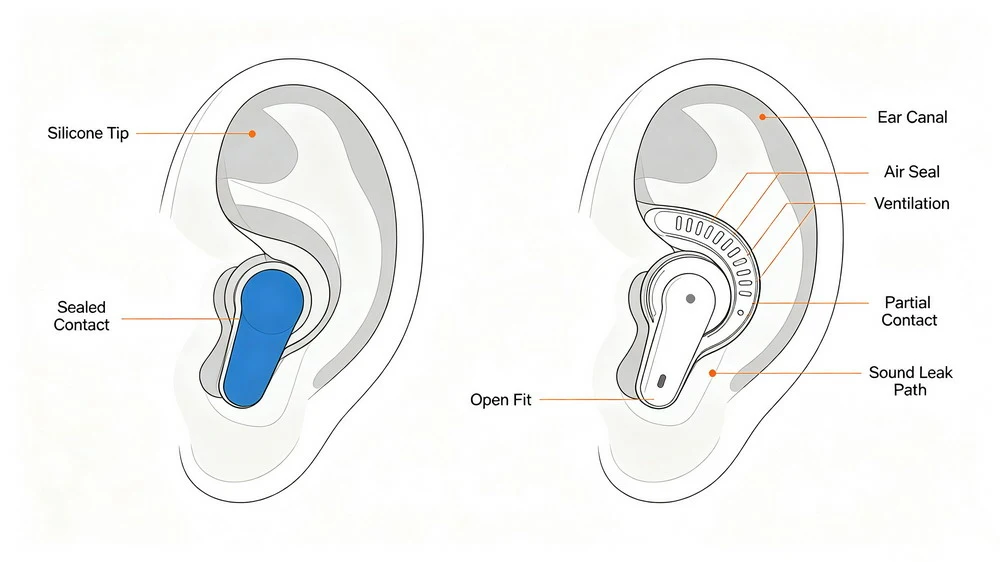
What Actually Separates In-Ear from Semi-In-Ear Earbuds
Acoustic Seal and Ear Canal Contact
The defining difference isn’t size or shape — it’s whether the earbud forms a seal inside the ear canal.
In-ear (canal-style) earbuds use a silicone or foam tip that sits inside the canal and creates a closed acoustic chamber. That seal is what gives them their bass response and passive noise isolation — the driver is playing into a small, enclosed space, so low frequencies build up efficiently.
Semi-in-ear earbuds — sometimes called half-in-ear — rest at the entrance of the canal or against the concha (the outer bowl of the ear) without sealing anything. Sound radiates into an open space instead of a closed chamber, which changes the whole acoustic design brief for your engineering team.
This one structural choice cascades into almost every spec on your data sheet: driver size, port tuning, mic placement, and — as we’ll get to — whether ANC is realistic at all.
Shell and Ear-Tip Tooling Differences
From a tooling standpoint, in-ear designs are usually the more mature, lower-risk mold. The shell is small, the ear tip is a separate silicone component (often available in stock sizes from your tip supplier), and the acoustic port design is well understood by most Shenzhen and Dongguan mold houses.
Semi-in-ear shells are trickier. Because there’s no tip to hold the driver in place, the housing itself has to do the work of staying seated on the ear — which usually means more R&D on the ergonomic shape, sometimes an ear hook or wing, and more rounds of fit-testing across different ear sizes before the mold is locked. If you’re opening a new mold rather than modifying an existing public mold, budget for more DFM (design-for-manufacture) rounds on a semi-in-ear shell than you would for a standard canal bud.
Sound Quality, Isolation, and ANC/ENC Feasibility
Passive Isolation and Bass Response
Because in-ear buds physically block the canal, they deliver noticeably stronger passive noise isolation and tighter bass — no electronics required. That’s why they’re still the default choice for commuters, gym-goers who want music over gym noise, and any customer segment where “loud environment, needs isolation” is the primary use case.
Semi-in-ear buds, with no seal, leak both ways: ambient noise gets in, and your audio leaks out at higher volumes. Bass response is inherently weaker unless the acoustic engineering compensates with driver tuning or a passive bass port — and even then, it won’t match a sealed design at the same driver cost.
Why ANC Is Harder on Semi-In-Ear Platforms
This is the point where a lot of buyers get surprised. Active Noise Cancellation works by generating an inverse waveform inside a sealed cavity — it needs that seal to be effective, especially for low-frequency noise like engine rumble or HVAC hum. Strip the seal away and ANC has almost nothing to work against.
That doesn’t mean semi-in-ear ANC is impossible. Several chip vendors — including Qualcomm — now ship adaptive ANC algorithms tuned specifically for open or semi-open designs, and leakage-compensation algorithms have improved a lot over the last two product cycles.
But the noise reduction depth on a semi-in-ear ANC bud will typically land well below what the same chipset delivers on a sealed in-ear design, and it needs a more sophisticated feedforward/feedback mic array plus tighter algorithm tuning to get there. If a customer wants to market “ANC” on a semi-in-ear SKU, set expectations early: it’s a real feature, but it’s not the same depth of cancellation buyers associate with sealed earbuds, and it needs its own round of validation testing before you print it on the box.
Call Quality and ENC
ENC (call noise reduction) behaves more consistently across both form factors because it works on the outgoing mic signal rather than the acoustic chamber the driver plays into. A dual-mic or multi-mic ENC array can be tuned effectively on either shell type, though semi-in-ear designs often need the mic ports positioned more carefully since there’s less housing mass to shield them from wind and handling noise. If your buyers care about call clarity specifically, it’s worth reading our breakdown of ANC vs ENC — the two features solve different problems and shouldn’t be conflated in a spec sheet.
Comfort, Wear Time, and Ear Health Considerations
Occlusion Effect and Long-Wear Fatigue
The sealed chamber that gives in-ear buds their bass also causes the occlusion effect — the user’s own voice, chewing, and footsteps sound amplified and boomy. Combined with constant pressure against the canal wall, this is the main driver of “I can’t wear these for more than two hours” complaints on in-ear SKUs.
Semi-in-ear buds avoid this almost entirely. No seal means no occlusion effect and no canal pressure, which is exactly why this form factor keeps showing up in office headset, all-day-wear, and hearing-conscious product lines.
Hygiene and Ear Canal Health
This rarely makes it into a product brief, but it matters for after-sales complaints: deep canal insertion traps moisture and wax against the canal wall, which is a factor in irritation complaints for humid climates or heavy-sweat use cases. Semi-in-ear designs, sitting outside the canal, largely sidestep this. If your target market is fitness-focused or based in a hot, humid region, this is worth surfacing in your product marketing, not just your spec sheet.
Matching Chipset Platforms and Components to Each Form Factor
Chipset choice isn’t purely about the shell shape, but the form factor does narrow your realistic options:
Qualcomm QCC series — a solid choice for either form factor when the target market cares about codec quality (aptX support) and stable connection at a mid-to-premium price point. On semi-in-ear ANC builds, make sure you’re on a QCC variant with a mic array and ANC feature set actually validated for open designs, not just repurposed from a sealed reference design.
Airoha — widely used across both categories, strong cost-to-feature ratio, common in high-volume in-ear ANC and ENC SKUs.
BES (Bestechnic) — frequently the platform of choice specifically for semi-in-ear and open-style ANC builds, since several BES reference designs are tuned for open acoustic architectures rather than adapted from sealed ones. If a supplier proposes BES for a semi-in-ear ANC SKU, that’s usually a sign they’re using an appropriate reference design rather than forcing a sealed-earbud platform into an open shell.
Jieli — a common pick for budget in-ear and semi-in-ear SKUs without ANC, where landed cost matters more than noise-cancellation depth — think promotional earbuds, bulk giveaway units, or entry-price Amazon listings.
The takeaway for buyers: don’t just ask “what chipset are you using,” ask “is this chipset’s ANC/ENC reference design validated for this shell type.” A platform that performs beautifully in a sealed in-ear bud can underperform badly in an open semi-in-ear shell if the acoustic tuning wasn’t done for that architecture.
Matching Form Factor to Target Market and Use Case

Chipsets and tooling aside, the real question is who’s buying the finished product — this is the same buyer-journey logic we walk through in our OWS and open-ear earbuds manufacturer guide. A few patterns we see repeatedly across Amazon sellers and brand clients:
Outdoor and safety-conscious users — runners, cyclists, warehouse and delivery workers — consistently prefer semi-in-ear or open designs because situational awareness (hearing traffic, forklifts, coworkers) outweighs deep bass and isolation.
Commuters, students, and gamers — anyone in a loud, shared environment wants isolation first. In-ear with decent passive isolation, or in-ear with ANC, wins here.
Office and call-center headsets, all-day wearables — comfort over 6–8 hours beats audio immersion. Semi-in-ear is the more forgiving choice, and it also photographs better for lifestyle marketing aimed at “wear it all day” positioning.
Promotional, bulk-buy, and gift SKUs — price sensitivity usually dominates. Either form factor works, but semi-in-ear designs are sometimes cheaper to tool at volume once the base shell is validated, since they skip the ear-tip supply chain entirely.
Private label brands entering a crowded niche (fitness, gaming, business) — this is where getting the form factor wrong is most expensive. A fitness brand launching a sealed in-ear SKU is fighting the market’s expectation of an open, secure-fit design; a business/office brand launching a heavily-sealed ANC bud may be over-engineering for a customer who mostly wants comfort and clear calls.
If you’re not sure which segment your listing is actually competing in, that’s worth resolving before you lock a mold — not after your first 3PL restock runs into return-rate problems.
Sourcing Considerations: MOQ, Tooling, and Certification
A few practical differences buyers should plan around when comparing quotes:
MOQ and tooling cost. Modifying an existing in-ear public mold is typically the fastest, lowest-MOQ path to a private-label SKU. A fully custom semi-in-ear shell — especially one with an ear hook or wing — usually needs a higher MOQ to justify the extra tooling and fit-testing rounds.
Sample and DFM cycles. Expect more fit-validation rounds on a new semi-in-ear shell across different ear sizes, since there’s no tip to compensate for variation the way there is on in-ear designs.
Certification scope is the same either way. FCC (searchable via the FCC ID database), CE, RoHS, and BQB Bluetooth SIG qualification apply regardless of form factor, and lithium battery shipments still need UN38.3 documentation. If you’re shipping into the UK or Australia/NZ, budget for UKCA and RCM respectively. Don’t let a supplier tell you semi-in-ear designs are exempt from any of this — the certification requirements track the radio and battery, not the shell shape.
AQL and IQC checkpoints. For semi-in-ear SKUs, add a specific fit/retention check to your AQL sampling plan (does it stay seated during a shake or light movement test) — this is a defect category that simply doesn’t exist on sealed in-ear designs but drives real return volume if skipped.
How Tashells Audio Supports Both Product Lines
We build both form factors out of our Fenggang, Dongguan facility, and we intentionally don’t push every buyer toward one shape.
If your product brief is a fitness or all-day-wear SKU, we’ll usually recommend starting from a proven semi-in-ear platform with a BES or Airoha reference design rather than forcing ANC onto an open shell that wasn’t designed for it. If isolation and bass are the priority, our in-ear ANC platforms on Qualcomm QCC or Airoha are the more direct path to a competitive spec sheet at a reasonable MOQ.
Either way, the in-ear vs semi-in-ear earbuds decision follows the same process on our side: confirm target market and use case first, then match chipset and tooling to that — not the other way around.
FAQ
Are semi-in-ear TWS earbuds good for running and workouts? Generally yes, for most runners and cyclists — the lack of a seal preserves situational awareness (traffic, other people) and avoids the pressure buildup that can make sealed buds uncomfortable during a sweaty, high-movement session. For high-intensity training where secure fit matters more than awareness, an in-ear design with an ear hook or wing tip can still outperform a plain semi-in-ear shell on retention.
Do semi-in-ear earbuds fall out more easily than in-ear models? They can, since there’s no tip anchoring them in the canal — retention depends more on the shell’s ergonomic fit against your ear shape. This is exactly why fit-testing across ear sizes matters so much during the sampling stage of a custom semi-in-ear project.
Can semi-in-ear earbuds support ANC as well as in-ear models? They can support ANC, but not to the same noise-reduction depth, because ANC works best inside a sealed cavity. If a target listing needs to compete on ANC performance specifically, an in-ear platform will generally out-perform a semi-in-ear one at the same chipset tier.
Which form factor is better for office or all-day wear? Semi-in-ear tends to win here on comfort alone — no occlusion effect, no canal pressure, and less ear fatigue over a full workday. Brands building office or WFH-focused SKUs should weigh that comfort advantage against the isolation trade-off before locking a design.
Is one form factor cheaper to source than the other? Not inherently — cost depends more on chipset tier, ANC/ENC inclusion, and whether you’re modifying an existing mold versus opening a new one. As a general pattern, modifying a proven in-ear public mold is usually the fastest, lowest-MOQ route to a private-label launch, while a fully custom semi-in-ear shell typically needs a higher MOQ to absorb the extra tooling and fit-testing cost.
Do in-ear and semi-in-ear earbuds need different certifications? No — FCC, CE, RoHS, BQB, and UN38.3 (for battery shipments) apply based on the radio and battery inside the product, not the shell shape. Budget for UKCA or RCM as well if you’re shipping into the UK or Australia/New Zealand.