Top TWS Earbuds Manufacturers in China: How to Actually Find One
Search “top TWS earbuds manufacturers in China” and you’ll get a dozen ranked lists — most written by content agencies, not anyone who has actually placed a purchase order. They repeat the same names, cite ratings nobody can verify, and rarely explain what separates a real factory from a trading company reselling someone else’s earbuds under a new logo.
That’s the problem with ranking lists: a number next to a company name doesn’t tell you whether they can hold ANC tuning consistent across a 5,000-unit run, or whether their “certifications” are current. What actually matters is whether you can verify a supplier’s capability yourself, using criteria that hold up regardless of which factory you’re evaluating.
This guide covers those criteria — manufacturing model, chipset platform, certification scope, MOQ transparency, and production verification — so you can evaluate any TWS earbuds manufacturer in China, not just the names that show up on someone else’s top-10 list.
What “Top” Should Actually Mean When You’re Sourcing
A manufacturer being “top” in a listicle usually means one of three things: they paid for a sponsored placement, they have a well-optimized company website, or they’re simply well-known to consumers (which says nothing about their OEM/ODM service quality). None of those correlate with whether they’ll ship a consistent product to your spec.
For a buyer actually placing an order, “top” should mean:
They can name their chipset platform and codec support without hesitation, not just “Bluetooth 5.3.”
Their certification documents match the product you’re ordering — not a different SKU.
Their MOQ and sample lead time are stated upfront, not negotiated case-by-case to obscure minimums.
They can walk you through their QC checkpoints (IQC, DUPRO, AQL sampling) in specific terms.
They’re a manufacturer, not a trading company — meaning they own or directly control the production line.
The Manufacturing Clusters Behind China’s TWS Output
Most of the manufacturers worth evaluating sit inside the same geography: the Pearl River Delta. Shenzhen holds the concentration of audio IC design houses and R&D talent; Dongguan (including towns like Fenggang and Qingxi) carries a large share of driver unit and injection-molding capacity; Huizhou and parts of Guangzhou fill out PCBA and accessory supply. This density is why lead times and component sourcing in the region beat almost anywhere else — a factory here can source a replacement chipset or battery cell from a supplier twenty minutes away instead of waiting on an import.
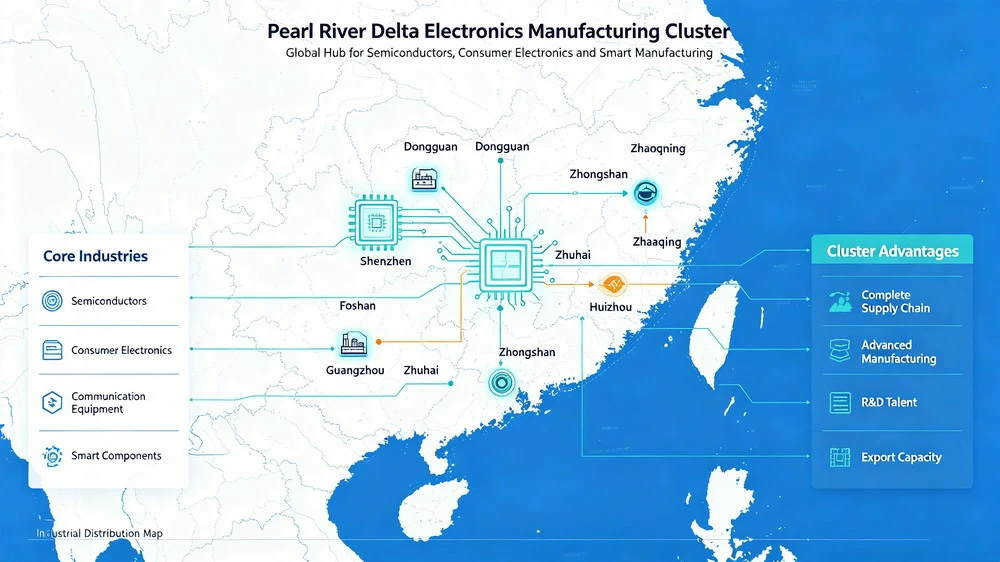
Knowing this matters when you’re vetting a manufacturer’s address. A company claiming full in-house production but based somewhere outside this belt, with no stated component supply chain, is worth a second look.
Five Criteria That Separate Top-Tier Manufacturers From Resellers
Manufacturing Model: OEM, ODM, or Hybrid
Ask directly which model a factory operates under, because the answer changes your entire timeline and cost structure.
OEM — you supply the full spec (CAD, BOM, firmware logic), the factory builds it. Best when your IP or acoustic tuning is core to your brand differentiation.
ODM — the factory proposes a validated reference design (chipset, driver, case dimensions already proven), you adapt branding and minor functional changes. Faster to market, lower NRE cost, and usually a lower MOQ.
Hybrid — joint development where the factory owns mechanical/acoustic engineering and you own firmware and branding.
A manufacturer that can only quote OEM, with no ODM reference designs to show you, usually has thinner in-house R&D than they present.
Chipset Platform Capability
The chipset determines codec support, power draw, ANC/ENC algorithm quality, and ultimately how the product performs in a customer’s ear. A manufacturer worth calling “top” should be fluent across multiple platforms, not locked into one:
Qualcomm QCC series — strong for aptX/aptX Adaptive support and premium-tier positioning.
Airoha — common in mid-to-premium builds with solid ANC performance.
BES (Bestechnic) — widely used where ENC (call noise cancellation) matters more than ANC, at a lower BOM cost.
Jieli — typically found in cost-driven, high-volume SKUs.
Ask which platform they’d recommend for your target price point and use case — a factory that recommends the same chipset regardless of your answer is quoting from a single production line, not matching a solution to your product.
Certification Scope
Export-ready TWS earbuds need certifications matched to destination market, not a generic “we’re certified” claim:
FCC (US), CE and RoHS (EU), UKCA (UK), RCM (Australia)
BQB (Bluetooth qualification, required for any Bluetooth-branded product)
UN38.3 (lithium battery air/sea transport)
Certificate numbers should be checkable against the issuing body’s database — a supplier who hesitates to share them usually has a reason. A manufacturer who can’t produce documents matching your exact SKU — not a similar one — isn’t ready for your order.
MOQ and Sampling Transparency
Top-tier manufacturers state their MOQ structure upfront: logo-only customization typically starts lower (100–300 units), full OEM with custom molds and firmware usually starts higher (1,000+ units). If a supplier avoids a straight answer or keeps “adjusting” MOQ depending on how eager you sound, that’s a signal, not a negotiating win.
Sample turnaround matters just as much — a factory that can’t commit to a sample lead time likely doesn’t have dedicated sampling capacity separate from mass production lines.
Verifiable Production Capacity
This is the step most ranking lists skip entirely: verifying that a company actually manufactures, rather than sources from another factory and relabels the box.
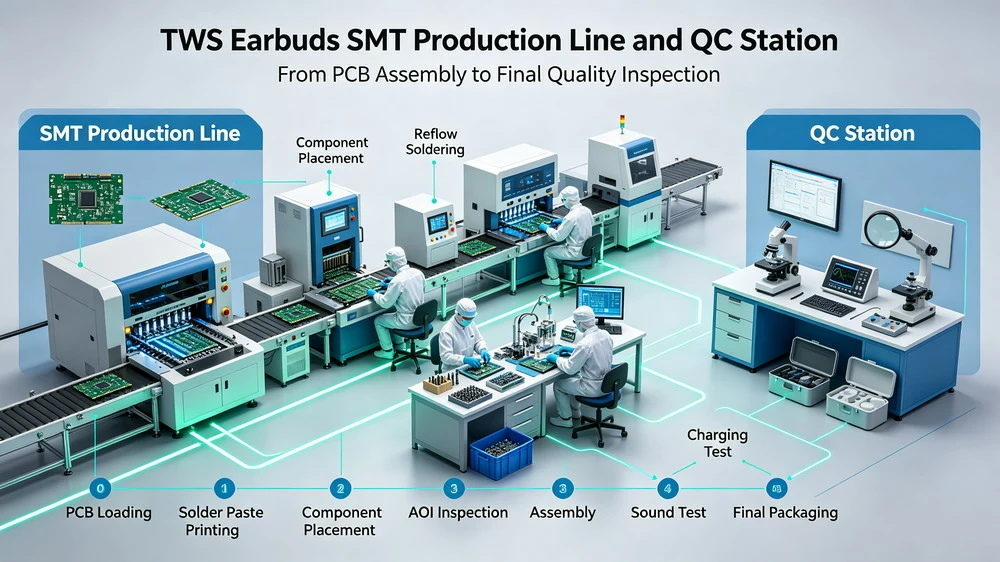
Request photos or a live video walkthrough of the SMT line, injection molding shop, and final assembly/QC station.
Confirm IQC (incoming quality control), DUPRO (in-process inspection), and AQL sampling standards used at final QC.
Cross-check the business license and export credentials against China’s national enterprise credit information system.
Where Tashells Audio Fits This Framework
We run through this same checklist internally, so it’s worth being transparent about where we sit on it. Tashells Audio (operated by Shenzhen Kasuga Electronic Co., Ltd., founded 2009) is based in Fenggang, Dongguan — inside the cluster described above, with driver and component sourcing available locally rather than shipped in. Measured against the five criteria above:
Manufacturing model — Both OEM and ODM lines, with a set of pre-validated ODM platforms (ANC, ENC, open-ear) that support lower MOQs for buyers testing a new SKU, alongside full custom OEM builds for brand owners with finished specs.
Chipset platform — Production lines work across Qualcomm QCC, Airoha, and BES, so the recommendation is matched to your price point rather than to whichever line happens to be free that month.
Certification scope — FCC, CE, RoHS, BQB, and UN38.3 documentation on file, with guidance on which apply to your target export market.
Production verification — Factory video audits and pre-shipment sample runs available before any production commitment.
None of that is a claim to being the only option — it’s the same list any serious manufacturer should be able to answer, and it’s worth running every factory you’re evaluating through it, us included.
Matching the Right Manufacturer to Your Order Profile
The “best” manufacturer depends heavily on who’s asking:
Amazon sellers testing a new SKU typically get more value from an ODM platform with proven reference designs — faster to market, lower NRE, easier to iterate if the first version doesn’t sell.
Wholesale distributors and trading companies need stable multi-SKU inventory and consistent lead times more than deep customization — prioritize factories with strong current-stock programs.
Brand owners building a differentiated product need full OEM capability — custom tooling, firmware control, and a manufacturer willing to co-develop rather than just execute a spec sheet.
Matching your buyer type to the manufacturing model above will narrow the field faster than any ranked list.
FAQ
How do I choose a reliable TWS earbuds supplier in China? Verify their manufacturing model (OEM/ODM vs. trading company), confirm certification documents match your exact SKU, ask for a live factory walkthrough, and order a paid sample before committing to a production run. Reliability shows up in documentation and process transparency, not in marketing claims.
What’s the difference between OEM and ODM for earbuds manufacturing? OEM means you supply the full design (CAD, BOM, firmware) and the factory builds to your spec. ODM means the factory proposes an already-validated reference design that you customize for branding and minor features — typically faster and cheaper to launch, but with less differentiation than a full custom build.
What’s the minimum order quantity (MOQ) for custom TWS earbuds? Logo-only customization on an existing case design usually starts around 100–300 units. Full OEM builds with custom molds, firmware, and packaging typically start at 1,000+ units, though this varies by manufacturer and product complexity.
Which certifications does a TWS earbuds manufacturer need for export? At minimum: FCC for the US, CE and RoHS for the EU, UKCA for the UK, BQB for any Bluetooth-branded product, and UN38.3 for lithium battery air/sea transport. Confirm the certificate numbers match your specific product model, not a similar SKU from the same factory.
How much does it cost to manufacture TWS earbuds in China? Cost depends primarily on chipset platform, ANC/ENC capability, battery size, tooling requirements, and order volume. Entry-level ODM products on an existing platform cost significantly less than a fully custom OEM design requiring new molds and firmware development.
Ready to Evaluate a Manufacturer?
If you’re comparing top TWS earbuds manufacturers in China right now, run each one through the five criteria above before you request a quote — manufacturing model, chipset platform, certification scope, MOQ transparency, and verifiable production capacity. For a deeper walkthrough of the sourcing process end to end, see our earbuds manufacturer guide. If you’d like to see how Tashells Audio holds up against that checklist for your specific product, request a quote or sample via john@tashells.com or WhatsApp +86 198 0675 8570.