How to Avoid a Low Quality Earbuds Supplier
Nobody sets out to work with a bad earbuds factory, and yet every buyer who ends up with a container of earbuds that fail pairing, crackle on one channel, or die after eighty charge cycles thought they’d done their homework.
This guide gives you the specific red flags to check for, a verification checklist to run before you send a deposit, and what to do if you’re already stuck with a bad batch — not general sourcing advice, but the exact signals that separate a factory you can build a business on from one that’s optimizing for a single order.
Here’s the pattern worth understanding first: the sample was fine. It’s the bulk order that wasn’t. That gap — between what looks fine at the quoting stage and what actually ships in volume — is where most low quality earbuds suppliers hide.
They’re not usually running an outright scam. They’re cutting corners in ways that don’t show up until you’re already committed: swapping a batch of drivers mid-run, skipping a QC checkpoint under deadline pressure, subbing in a cheaper Bluetooth chip that “should” behave the same as the one you approved.
This assumes you’ve already got a shortlist of candidates. If you’re still building that list, our guide on how to find an earbuds supplier covers that earlier step.

Why Low Quality Suppliers Are Hard to Spot Before You Order
Most sourcing guides tell you to check for FCC, CE, and RoHS certificates, ask for MOQ terms, and request a sample. That’s necessary, but it’s the floor, not the ceiling. Every factory on Alibaba can produce a clean-looking certificate PDF and a good sample unit — a strong sample is table stakes, not proof of anything.
The real signal isn’t in what a supplier shows you. It’s in how they behave when you ask questions they didn’t prepare an answer for. A legitimate manufacturer can tell you, without checking with someone else, which chipset platform runs their board — Qualcomm QCC, Airoha, BES, or Jieli — and why they chose it for your price point. A trading company repackaging output from three different factories usually can’t, because they don’t control the bill of materials in the first place.
Red Flags to Watch Before You Send a Deposit
Vague or Shifting Certification Claims
Ask a real factory for their FCC ID and CE Declaration of Conformity, and they hand it over within a day, because they already have it on file for exactly this question. Stalling, sending a certificate for a different model number, or answering “in progress” is where a low quality supplier tends to show itself. Hearing “in-progress” once is fine — it’s a problem when that’s the answer to every certification question, across every product they show you.
Cross-check the FCC ID against the FCC’s own equipment authorization database before you accept it. It takes two minutes and catches more borrowed or reused IDs than you’d expect. If the product uses the Bluetooth logo, it should also carry a valid listing in the Bluetooth SIG qualification database — a supplier that can’t point you to their own listing there usually hasn’t done the qualification at all.
No Traceable Factory, Only a Trading Company Identity
There’s nothing wrong with buying through a trading company — plenty are good at what they do. The problem shows up when a supplier presents itself as a manufacturer while actually subcontracting to whichever factory has open capacity that month, because then “the factory” making your earbuds isn’t fixed, and you lose consistency between orders.
Ask directly: do you own the SMT lines, or do you subcontract assembly? Owning production gets you a one-sentence answer. A story about “our partner facilities” instead is telling you something about how much control they actually have over your product.
It’s also worth checking the business license itself. China’s National Enterprise Credit Information Publicity System is public and free — you can confirm the registered company name matches the name on your invoice and quote, which catches the “quotes under one name, invoices under another” mismatch before money moves.
Refusal to Allow Video Tours or Third-Party Audits
Production lines, QC stations, packaging area — a working factory has nothing to hide on a video call, and all of it should be visible in fifteen minutes. When a supplier keeps postponing a live video tour, or pushes back hard on a third-party inspection (SGS, Bureau Veritas, QIMA), that resistance is the data point. Legitimate manufacturers accept pre-shipment inspection as a normal cost of doing business, because they’re not worried about what an inspector will find.
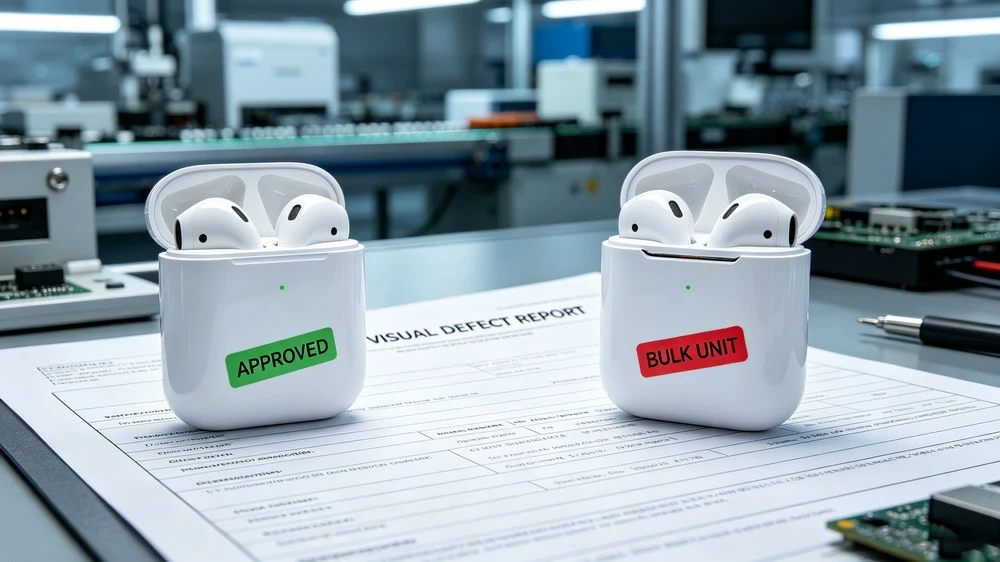
Sample Quality That Doesn’t Match Bulk Production
This is the one that catches even experienced buyers. A supplier hand-finishes a showroom sample — sometimes built in a completely different, better-equipped facility than the one that will run your actual order — to win the deal. Once the deposit clears, mass production uses the cheapest components that still fit the mold.
Two ways to reduce this risk: request that your sample be pulled from the same production line and materials batch that will run your bulk order, not a bench-built unit, and schedule a mid-production inspection rather than only checking the goods right before they leave the factory. By the time a pre-shipment inspection happens, a bad run is already finished and hard to fix without a full rework.
Our checklist of questions to ask an earbuds supplier covers what to ask about sample sourcing specifically, and our guide on how to test earbuds quality before a bulk order walks through what to check across multiple sample units, not just one.
Pressure Tactics Around Payment and MOQ
Watch how a supplier reacts to normal buyer caution. A factory confident in its own quality will negotiate MOQ, accept staged payment tied to inspection milestones, and let you walk away from small-batch testing before committing to volume. A supplier pushing for 100% prepayment, discouraging a trial order, or offering an MOQ that’s suspiciously lower than everyone else quoted you is usually optimizing for getting your deposit — not for a repeat order twelve months from now.
If nine quotes cluster around a similar unit price and one comes in dramatically lower with no clear explanation, that’s not a deal. It’s a warning that something in the build — component grade, QC headcount, or the certifications themselves — isn’t what’s on the spec sheet.
What a Legitimate Manufacturer Actually Looks Like
Strip away the sales language, and a trustworthy TWS earbuds supplier tends to share a handful of concrete traits:
Names its chipset platform, battery cell supplier, and driver source without hesitation
Provides certification documents that match the exact model and revision you’re ordering, not a generic version
Agrees to video tours and third-party inspection as a matter of routine, not as a special favor
Offers a trial or small-batch order path instead of insisting on full MOQ from a first-time buyer
Has been exporting to your target market long enough to have handled a customs or compliance issue before — and can explain how they resolved it
Laid out side by side, the pattern is easier to spot in the moment:
| Signal | Legitimate manufacturer | Low quality supplier |
|---|---|---|
| Certification | FCC ID verifiable same-day | “In progress” every time you ask |
| Production ownership | States directly they own the SMT lines | Vague about “partner facilities” |
| Factory access | Offers live video tours, welcomes third-party audits | Repeatedly postpones or refuses |
| Sample sourcing | Sample pulled from actual production batch | Hand-finished showroom unit |
| Payment terms | Accepts staged payment tied to inspection | Pushes for 100% prepayment |
None of this replaces due diligence. But a supplier who checks most of these boxes without being pushed is behaving like a company planning to still be your supplier next year, not one optimizing for a single order. For a longer walkthrough of what “reliable” actually means in practice, see our guide on how to choose a reliable earbuds supplier.
A Practical Verification Checklist Before You Commit
Request the FCC ID and CE Declaration of Conformity, then verify the FCC ID independently against the FCC database.
Ask who owns the production line — get a direct answer, not a description of “partner facilities.”
Schedule a live video walkthrough of the factory floor, not a pre-recorded promotional video.
Confirm your sample comes from the same production batch and tooling that will run your bulk order.
Book a mid-production inspection in addition to (not instead of) a pre-shipment inspection.
Compare payment terms across at least three suppliers — treat an outlier MOQ or prepayment demand as a question, not a discount.
Ask for two buyer references from orders of similar size, and actually contact them.
What to Do If You’re Already Working With a Low-Quality Supplier
If a batch already shipped with a defect rate above what your contract allows, don’t treat the next order as a chance to “give them one more shot” without changes. Document the defect rate with photos and inspection reports, request a corrective action plan in writing, and insist on a pre-shipment inspection on the very next order regardless of past history. If the supplier resists any of those three, that’s usually the answer about whether the relationship is salvageable.
Switching suppliers mid-product-line is disruptive, but it’s less expensive than repeating the same defect rate across another 5,000-unit order. If you’re trying to figure out whether what you’re seeing is a normal tolerance issue or a real quality failure, our breakdown of common quality problems in cheap earbuds is a useful reference point.
How We Handle This at Tashells Audio
We build TWS, ANC, and open-ear earbuds for Amazon sellers, wholesale distributors, and private label brands out of our facility in Fenggang, Dongguan. We share our FCC and CE documentation before a deposit is discussed, not after, and we run production on our own SMT lines rather than subcontracting to whichever factory has open capacity that week.
Buyers are welcome to request a live video walkthrough or bring in a third-party inspector at any stage — that’s a normal part of how we work, not an exception we make for larger orders. Our full quality control process covers incoming material inspection through pre-shipment checks, and our OEM & ODM service page has more on how we structure custom projects.
If you’re evaluating suppliers for an upcoming earbuds order, reach out to our team with your target specs, and we’ll walk you through our certification documents and production process directly.
FAQ
How do I know if an earbuds supplier is legitimate before ordering? Check that they can name their chipset platform and component suppliers without hesitation, verify their FCC ID independently through the FCC database, and confirm they’ll allow a live video tour or third-party factory audit. Hesitation on any of these is a stronger signal than anything printed on their company profile.
What’s the biggest red flag when sourcing earbuds from China? Refusal to allow a third-party pre-shipment inspection or live video tour. A factory with nothing to hide has no reason to keep delaying it.
Can a good sample still mean the bulk order is low quality? Yes. Sample bait-and-switch is one of the more common issues in earbuds sourcing — a polished sample wins the order, and mass production quietly downgrades components. Request that your sample come from the actual production batch and tooling, and schedule a mid-production inspection, not just a pre-shipment one.
Is it worth paying more for a certified earbuds manufacturer? Certifications like FCC, CE, and RoHS confirm legal market access, not manufacturing quality on their own — but a supplier that keeps its certification documentation current and matched to the exact model you’re ordering is usually also more disciplined about the rest of its QC process.
What should I do if my current earbuds supplier is already delivering low quality batches? Document the defect rate with photos and inspection data, request a written corrective action plan, and require a pre-shipment inspection on the next order no matter what history you have with them. If they resist any of those steps, treat that as your answer.
How many suppliers should I compare before choosing one? Get quotes and documentation from at least three to five suppliers. This makes it much easier to spot an outlier — a price that’s dramatically lower, an MOQ that doesn’t match the market, or certifications that don’t hold up next to what competitors readily provide.