How to Buy Wholesale TWS Earbuds from China
Most people who set out to buy wholesale TWS earbuds from China don’t fail because they picked the wrong factory. They fail because they skipped a step — jumped from “this quote looks good” straight to a deposit, without confirming what the deposit actually locked in.
This guide lays out the buying process in order, from defining your order profile to clearing customs on the other end. If you want the deeper reference material behind any step — MOQ tiers, chipset comparisons, certification checklists — our full wholesale TWS earbuds buying guide covers each of those in more depth. This article is the sequence you actually follow.
Why the Order of Steps Matters
A lot of first-time buyers treat sourcing as a single event: find a supplier, get a price, place the order. In practice it’s nine smaller decisions, and each one narrows your options for the next. Decide your MOQ before you talk to suppliers, and you’ll waste less time on factories that were never going to fit your order size. Confirm certifications before you approve a sample, and you won’t discover a compliance gap after the container has already left port.
None of these steps are complicated on their own. What trips buyers up is doing them out of sequence — or skipping the ones that feel like paperwork until a customs officer or an Amazon compliance team asks for them.

Step 1: Define Your Order Profile Before You Contact Anyone
Before requesting a single quote, know three numbers: your target unit cost, your realistic order quantity, and how much customization you actually need. A 300-unit test batch and a 5,000-unit annual program are different conversations with different suppliers, and walking into a factory chat without this framing wastes time on both sides.
If you’re an Amazon seller testing a new SKU, an off-the-shelf ODM design with a logo and color change is usually the right starting point — no tooling cost, shorter lead time. If you’re a brand owner planning to defend a design long-term, full OEM tooling makes more sense even though it costs more upfront. Decide which one you are first; it filters out roughly half the suppliers who’ll respond to your inquiry.
Step 2: Pick a Sourcing Route
There are three practical ways to source TWS earbuds wholesale from Chinese suppliers, and they suit different order sizes.
Direct factory sourcing gets you the lowest unit cost and the most control over specs, but expects a 30–50% deposit and more due diligence from you.
Trading companies sit between you and the factory, charging roughly a 15–30% markup in exchange for smaller MOQs, better English communication, and a buffer if something goes wrong.
Marketplace aggregators with ready stock are fastest when you need units now and don’t need customization, though pricing per unit runs highest.
A small test order has no business going straight to a factory demanding a 2,000-piece minimum — a trading company or low-MOQ ODM supplier is the better fit. A recurring 10,000-unit program is usually better served going direct, since the trading company’s cut adds up fast across repeat orders.
Step 3: Shortlist Suppliers and Verify They’re Real
Request quotes from three to five suppliers, not one. While you’re comparing pricing, verify each one is what it claims to be:
Ask for the business license number and cross-check it against China’s National Enterprise Credit Information Publicity System.
Request a live, unscripted video tour of the production floor — soldering stations, battery testing benches, QC tables. A real factory won’t hesitate; a trading company posing as one will stall or send a stock video.
Ask for two or three client references you can actually contact.
Watch for suppliers who demand full prepayment before any sample approval, dodge questions about certifications, or quote an MOQ that doesn’t match the customization they’re offering — a 50-unit minimum on a “fully custom” mold is a sign you’re talking to a reseller, not a factory.
Step 4: Lock In the Technical Spec
Get specific about chipset and codec before you get a final price, because both drive cost and performance more than any other line item.
| Chipset Platform | Typical Tier | Common Use |
|---|---|---|
| Qualcomm QCC | Premium | High-end ANC, multipoint stability |
| Airoha | Mid-to-premium | Solid ANC at lower BOM cost |
| BES (Bestechnic) | Mid-range | Balanced ANC/ENC feature set |
| Jieli (JL) | Budget | Basic Bluetooth pairing and playback |
For codecs, confirm what’s actually implemented in firmware, not just what the chipset supports in theory. AAC matters most if your buyers skew iPhone; aptX matters more for Android and latency-sensitive uses like gaming. Ask for the Bluetooth SIG Declaration ID too — every legally sold Bluetooth product needs one, and it’s separate from FCC or CE. Lock this down before you request final pricing; asking suppliers to quote before the spec is fixed is how you end up comparing quotes that aren’t actually for the same product.
Step 5: Get Comparable Quotes and Understand the Incoterm
A quote that just says “$4.20/unit FOB Shenzhen” tells you almost nothing on its own. Ask what’s included — charging cable, retail box, master carton, or just the bare unit — and get the incoterm spelled out. Skip this and you’ll find the mismatch later, when the purchase order in Step 7 doesn’t match what you thought you were paying for.
FOB (Free on Board) is the most common and buyer-friendly term: the supplier delivers to the port and loads the vessel, and you control freight and customs from there. EXW (Ex Works) looks cheaper on paper but shifts pickup and domestic transport onto you. CIF bundles freight and insurance into the price, which is convenient for a first-timer but usually hides the true shipping cost. For most wholesale buyers, comparing quotes on FOB terms gives the clearest apples-to-apples picture.
Also budget for costs that don’t show up on the factory quote: ocean or air freight, import duties, 3PL receiving fees, and pre-shipment inspection. These typically add 15–25% on top of the FOB unit price by the time goods land in your warehouse.
Step 6: Order and Physically Test Samples
Never approve a design off photos or a spec sheet. Order at least two to three samples per SKU and actually use them: test Bluetooth pairing speed and stability, record a call to check mic clarity, run the case through a few charge cycles to check battery decay, and check the hinge durability if there’s a lid. If touch controls are part of the design, test response latency yourself instead of trusting the spec sheet’s number.
For an ODM product with light customization, expect samples in 7–14 days. Full OEM development with new tooling takes several weeks longer before you see a first sample.
Step 7: Put Everything in Writing Before You Send the Deposit
Once samples pass, the purchase order needs to specify more than price and quantity. Include the AQL standard you’re using (most electronics orders run AQL 2.5 for major defects, AQL 4.0 for minor ones), who owns any custom tooling or firmware, the exact certifications required, and a delivery date with a penalty clause if it slips. A verbal agreement on quality expectations isn’t worth anything once a dispute starts — the written PO is what both sides fall back on.
Step 8: Confirm Certifications Before Production Finishes
Don’t wait until the shipment is packed to ask about compliance documents. Confirm in writing, before mass production, that the supplier will provide:
FCC documentation for US-bound shipments
CE and RoHS for the EU, UKCA if the UK is a separate destination
UN38.3 battery test documentation, required for any lithium-battery product moving by air or sea
Ask for the actual test reports with model number, testing lab, and date — not just a claim that “we have FCC.” Missing UN38.3 paperwork alone is enough to get a container held at the port, and there’s no fixing it retroactively once the shipment has left.
Step 9: Inspect Before Shipment, Then Track It to Your Door
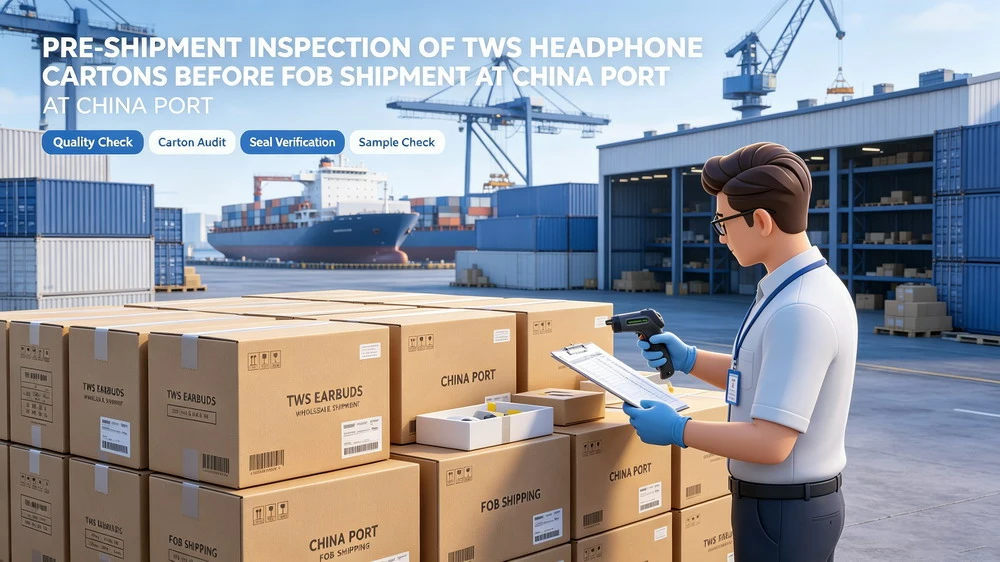
For orders above roughly $10,000, a third-party pre-shipment inspection (PSI) is worth the $250–$400 per inspector-day it typically costs. An independent inspector checks a statistical sample against your specified AQL before the goods leave the factory — while problems are still fixable on-site, not after they’ve crossed the ocean. Once the inspection passes, confirm the freight booking, get tracking details, and keep your compliance documents on hand for customs clearance at the destination port.
Where a Specialized Factory Like Tashells Audio Fits In
Not every supplier that shows up on a first search is built for a structured process like this one. Tashells Audio is a Shenzhen-based TWS earbuds manufacturer that has focused specifically on ANC and open ear lines rather than treating audio as one product category among many, and it offers lower-MOQ OEM and private label pathways for buyers who want to run this exact nine-step process without committing to a 5,000-unit order on day one.
If you’re ready to move from research to a real quote, our OEM & ODM service page and quality control process are a good next stop before you request pricing.
FAQ
How long does the whole process take, from first quote to delivered goods? For an ODM order with light customization, figure 4–6 weeks from confirmed spec to shipped product, plus ocean freight transit time. Full custom OEM development stretches to 3–4 months once tooling, sample rounds, and revisions are accounted for.
What’s a realistic MOQ for a first wholesale TWS earbuds order? Somewhere between 500 and 1,000 units is a common starting point for a first order with light ODM customization — large enough that most factories will take the inquiry seriously, small enough to limit downside while you validate the product.
Do I need a sourcing agent to buy wholesale TWS earbuds from China? Not necessarily, but it depends on what you’re comfortable handling yourself. An agent or trading company is doing three things for their cut: verifying the factory is legitimate, catching quality issues before they ship, and translating technical back-and-forth that’s easy to get wrong in a second language. If you’ve never placed a China order before, that’s usually worth paying for on the first one or two — you can always move to direct factory sourcing once you know what to check for yourself.
What certifications are legally required, not just recommended? FCC is required for anything with a Bluetooth radio entering the US market; CE and RoHS are required for the EU; UKCA applies separately to the UK. UN38.3 battery documentation is required for shipping lithium-battery products by air or sea, regardless of destination.
Can I buy a small test batch before committing to a bulk order? Yes — most ODM suppliers, including factories with dedicated low-MOQ programs, will run a few hundred units as a test batch before you scale to a full wholesale order. This is the safer sequence if you haven’t validated demand for the SKU yet.
What’s the biggest mistake first-time buyers make in this process? Skipping the sample and inspection steps to save time or money. A defect or missing certification caught in a 3-unit sample costs almost nothing to fix; the same problem caught after 5,000 units have shipped can mean a held container, a failed customer listing, or a full re-manufacturing run.
Final Thoughts
Buying wholesale TWS earbuds from China rewards buyers who work through the steps in order more than it rewards buyers who move fast. None of the nine steps above is difficult by itself — the risk comes from skipping ahead, usually on certifications or samples, because a supplier sounded confident enough to trust without verification.
Ready to start the process with a specific spec in hand? Request a quote from Tashells Audio’s OEM/ODM team, and we’ll walk you through MOQ, certifications, and FOB pricing based on your target market.