ANC vs ENC Earbuds: What’s the Difference?
If you’ve spent any time reading spec sheets for TWS earbuds, you’ve probably run into both acronyms sitting next to each other like they’re interchangeable. They’re not. I get this question from buyers constantly, usually after a listing got dinged in reviews for “the noise cancellation doesn’t work on calls” — which almost always turns out to be an ANC/ENC mix-up, not a defective unit.
Quick answer, then I’ll get into the mechanics: ANC (Active Noise Cancellation) cancels ambient sound for the person wearing the earbuds, so music and podcasts sound cleaner. ENC (Environmental Noise Cancellation) cleans up the microphone signal, so the person on the other end of a call hears your voice instead of your surroundings. One protects what you hear. The other protects what people hear from you.
Most mid-range and premium earbuds today ship with both, but they’re solving two completely different engineering problems. That distinction matters a lot once you’re deciding what to put on a spec sheet for production.
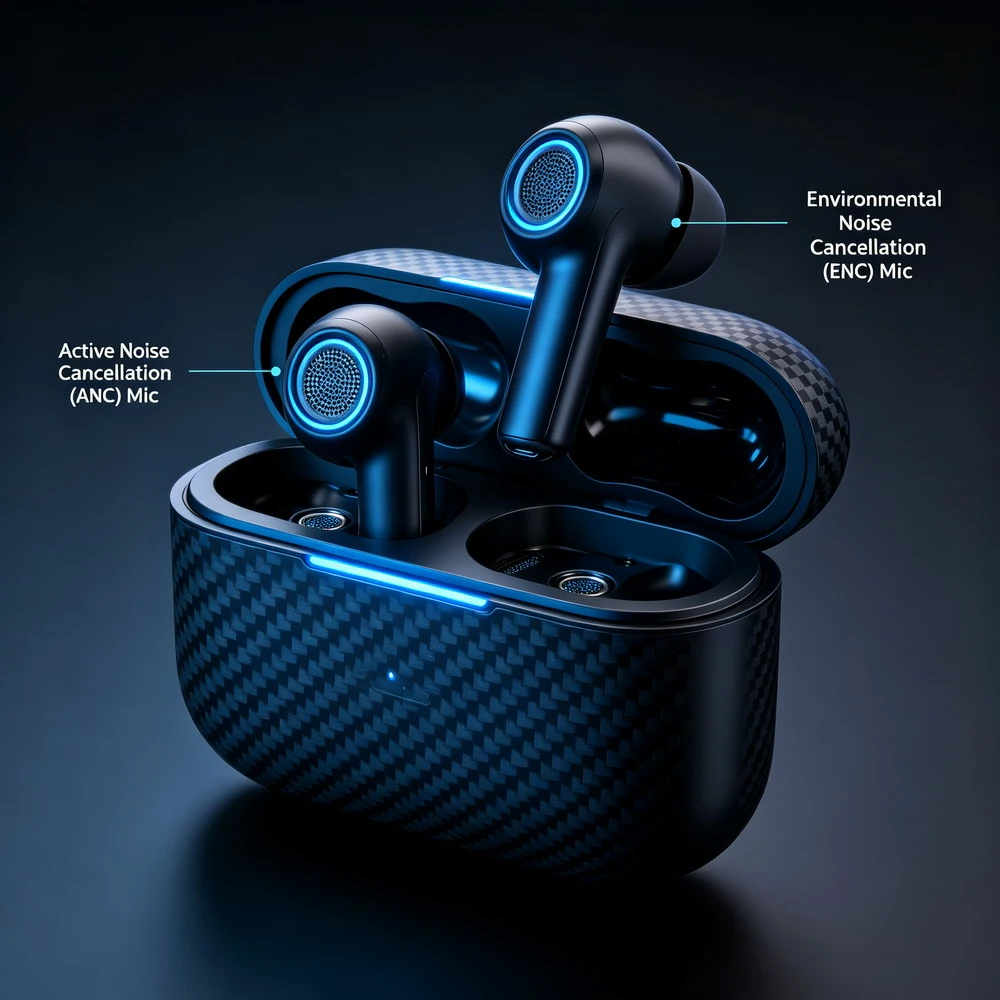
What Is ANC (Active Noise Cancellation)?
ANC is a listening-side technology. It exists to reduce the ambient noise reaching your eardrum — the drone of a plane cabin, HVAC hum in an open office, traffic outside a window. It doesn’t touch your voice or your microphone signal at all.
How ANC Works
The earbud uses one or more microphones to sample the noise around you in real time. A DSP chip then generates an inverted sound wave — same frequency, opposite phase — and plays it back through the driver alongside your audio. When the inverted wave meets the original noise wave, they cancel each other out before the sound reaches your eardrum.
This is phase-cancellation, and it’s most effective against steady, low-frequency noise: engine drone, fan noise, road hum. It’s much less effective against sudden or high-frequency sounds like a dog barking or a door slamming, which is why no ANC earbud claims to cancel “everything.”
Feedforward, Feedback, and Hybrid ANC
This is the part that actually matters for a spec sheet, and it’s where a lot of buyers get burned:
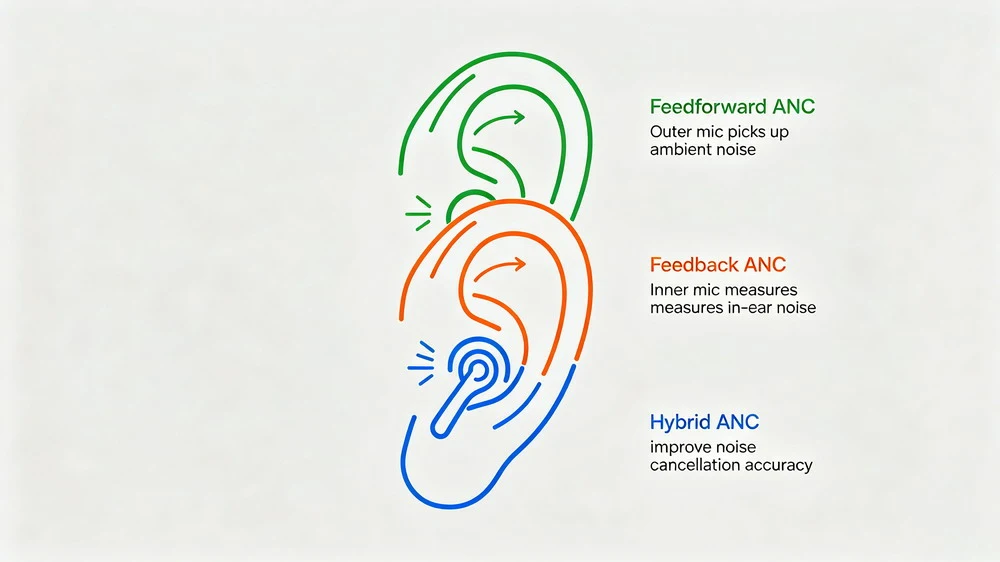
Feedforward ANC places the microphone on the outside of the earbud, sampling noise before it reaches the ear. Cheaper to implement, decent at mid-to-low frequencies, but the mic can’t hear what’s actually reaching your eardrum, so tuning tends to be less precise.
Feedback ANC places the microphone inside the ear canal, measuring what’s actually getting through and adjusting in real time. More accurate, but more sensitive to ear tip fit and seal quality.
Hybrid ANC uses both outer and inner microphones together. It’s the configuration most premium earbuds use today because it corrects for what feedforward alone misses, and it’s noticeably better in real-world environments like subway platforms or airplane cabins compared to feedforward-only builds.
If a factory quotes you “ANC” without specifying which architecture, ask. A feedforward-only build and a hybrid build can carry the same marketing claim on a listing while performing very differently in a customer’s ears — and that gap shows up in your return rate, not in the spec sheet. (We go deeper on how to pressure-test an ANC quote in our OEM ANC earbuds sourcing guide.)
What Is ENC (Environmental Noise Cancellation)?
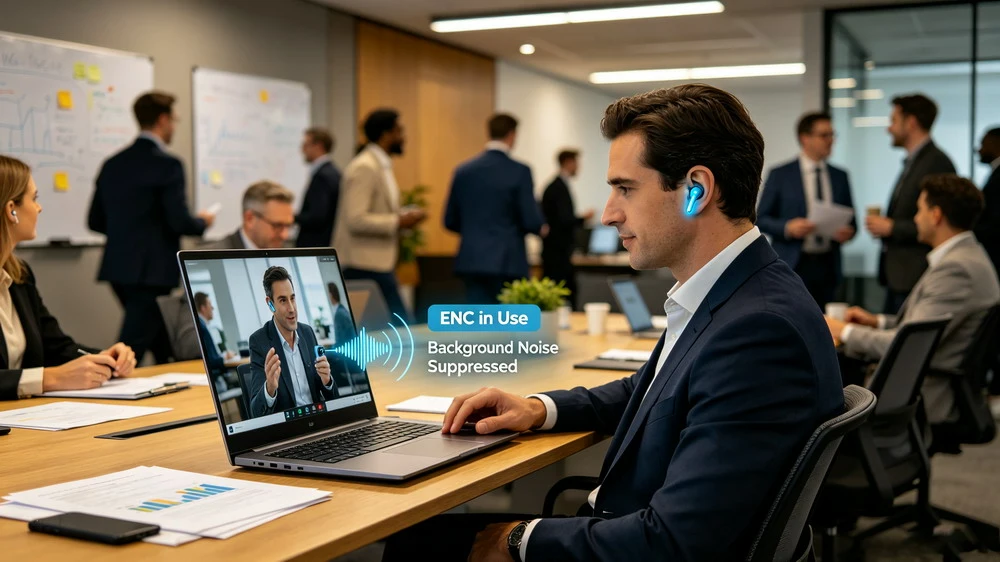
ENC is a talking-side technology. It has nothing to do with what you hear — it exists to make your voice sound clear to the person you’re calling, even if you’re standing in a noisy warehouse, a crowded café, or next to an open window with traffic outside.
How ENC Works
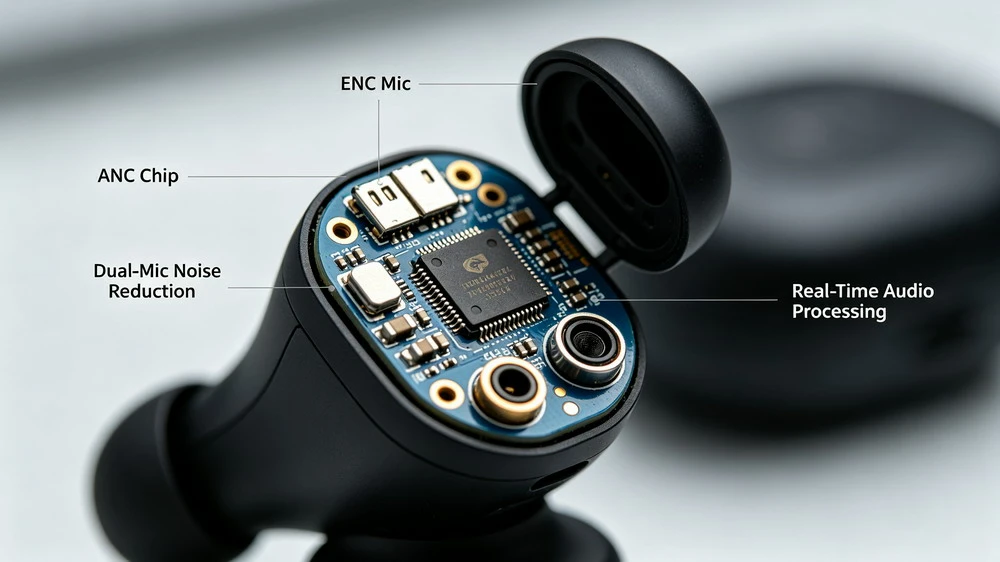
ENC uses multiple microphones — typically one closer to your mouth and one or more sampling ambient sound — plus onboard AI/DSP processing to separate your voice from everything else picked up by the mic array. The chip identifies the voice-frequency pattern, suppresses everything outside it (wind, keyboard clicks, background chatter, traffic), and sends a cleaned-up signal to the call.
None of this affects what you hear through the driver. If your customer complains that music doesn’t sound quieter on calls, that’s expected — ENC was never supposed to change playback.
Where ENC Matters Most
ENC earns its keep in call-heavy use cases: remote workers on back-to-back video calls, gig delivery drivers taking calls outdoors, gamers on voice chat, warehouse or field staff using push-to-talk. For product listings, this is the spec buyers search for when the keyword intent is “clear calls” rather than “block noise.”
ANC vs ENC: Key Differences at a Glance
| ANC | ENC | |
|---|---|---|
| Solves | Noise you hear | Noise others hear from your mic |
| Direction | Inbound (playback) | Outbound (call/voice) |
| Mechanism | Phase-inverted anti-noise waveform | AI/DSP voice isolation |
| Best for | Music, podcasts, flights, commutes | Calls, video meetings, voice chat |
| Typical chipsets | Qualcomm QCC, Airoha, BES (hybrid tier) | BES, Airoha, most mid-to-premium chipsets |
| Common architecture | Feedforward / feedback / hybrid | Dual/multi-mic + noise-suppression algorithm |
| Affects music playback? | Yes, directly | No |
| Affects call clarity? | No | Yes, directly |
Do You Need Both ANC and ENC?
For most product lines targeting general consumers, yes — and most mid-tier chipsets today support both natively, so there’s rarely a strong cost argument for shipping just one. The decision point is less “ANC or ENC” and more “how much do I invest in the tuning of each.”
If your end customer is a commuter or traveler buying primarily for music and podcasts, ANC quality (specifically, feedforward vs hybrid) is where the review complaints will come from if you cut corners.
If your end customer is buying for work-from-home calls, gaming voice chat, or outdoor use with frequent calls, ENC tuning matters more than ANC depth — nobody complains about ANC dB numbers on a product marketed for calls.
If you’re specifying for both, hybrid ANC plus multi-mic ENC is the combination I’d default to for anything above entry-level pricing. It’s also the combination most competitive Amazon listings in the $25–$60 bracket already claim, so shipping less puts you at a review disadvantage before launch.
Sourcing Considerations: Chipsets Behind ANC and ENC
The chipset determines what’s actually possible, regardless of what the marketing copy says. This is the part I always tell buyers to nail down before they approve a sample, not after.
Qualcomm QCC Series
Still the premium-tier reference. Strong hybrid ANC performance, broad codec support (aptX, aptX Adaptive, aptX HD, Snapdragon Sound on newer series), and the most mature ENC algorithms in the market. Higher BOM cost, so it shows up mostly in premium SKUs.
Airoha
The chipset that spun out of MediaTek’s audio division, and currently the workhorse for mid-to-premium ANC and ENC builds. Solid hybrid ANC, good LE Audio/LC3 readiness on newer generations, and a better cost-to-performance ratio than Qualcomm for buyers who don’t specifically need aptX-tier codecs.
BES (Bestechnic)
Common across cost-efficient TWS builds, and particularly strong where ENC is the priority over deep ANC. BES has well-validated reference designs across Shenzhen and Dongguan factories, which generally means shorter ODM lead times because the integration work is already proven.
Jieli (JL)
The budget end of the spectrum. Functional Bluetooth and basic ENC on newer generations, but generally without the processing headroom for hybrid ANC. Fine for entry-level SKUs; not the platform to spec if your listing is going to claim “premium noise cancellation.”
One habit worth building into every supplier call: ask directly which chipset is being quoted, and ask whether the ANC is feedforward, feedback, or hybrid. Factories that answer immediately and specifically tend to know their own hardware. Factories that redirect to marketing language like “premium sound chip” are worth a second look before you commit to a PO. Our OEM wireless earbuds checklist covers the rest of the questions worth asking before you approve a sample.
Choosing the Right Spec for Your Product Line
For Amazon sellers and brand owners deciding what to put in a listing, the chipset and ANC architecture you choose should follow the customer story you’re selling, not the other way around:
Travel/commute-positioned listings → lead with hybrid ANC, back it with a mid-to-premium chipset (Airoha or Qualcomm), and keep ENC as a secondary bullet.
Work-from-home/business-positioned listings → lead with multi-mic ENC and call clarity, and don’t overspend on ANC depth your target customer won’t stress-test.
Budget/bulk wholesale SKUs → Jieli-based builds are acceptable if you’re not making ANC claims. The mistake to avoid is advertising “ANC” on a chipset that can’t deliver hybrid-level performance — that’s a return-and-refund problem, not a marketing win.
For MOQ-sensitive Amazon sellers testing a new SKU before committing to a full production run, reduced-MOQ ODM options with paid samples let you validate ANC/ENC performance against your actual listing claims before you scale the order. Our TWS earbuds wholesale buying guide covers MOQ tiers and pricing by chipset in more detail if you’re scoping a first order.
None of this spec work matters if the shipment gets held at customs, though. Certification (FCC, CE, RoHS, BQB for Bluetooth qualification, UN38.3 for battery air freight, UKCA for the UK) confirms the product can legally enter your target market — it doesn’t confirm the ANC or ENC actually performs as claimed.
Those are two separate checks, and skipping the second one is how a fully-certified product still ends up with 1-star reviews about “noise cancellation that doesn’t work.” Ask your factory for real acoustic test data — anechoic chamber reports, not just a spec sheet number — before you approve bulk production on anything making a hybrid ANC or multi-mic ENC claim.
How Tashells Audio Supports ANC and ENC Earbuds Sourcing
Tashells Audio has been producing TWS earbuds out of its Dongguan facility since 2009, and ANC/ENC configuration is one of the most common technical conversations we have with Amazon sellers and brand owners before they finalize a spec. We work across Qualcomm QCC, Airoha, BES, and Jieli platforms, so the chipset conversation happens based on your target price point and the customer story your listing is telling — not because it’s the only platform we happen to stock.
For sellers testing a new SKU, we offer reduced-MOQ ODM options and paid samples so you can validate ANC and ENC performance against your actual product claims before committing to a full production run. You can see the full range of platforms and certifications we support on our earbuds manufacturer guide.
FAQ
What is the main difference between ANC and ENC in earbuds? ANC reduces the ambient noise you hear while listening to music or media. ENC filters background noise picked up by the microphone so the person you’re calling hears your voice clearly. One works on playback, the other works on your outgoing mic signal.
Do I need both ANC and ENC in a pair of earbuds? Not strictly, but most mid-tier chipsets support both, so there’s little cost reason to ship only one. Which one to prioritize in tuning depends on whether your product is positioned around music/travel use (favor ANC) or calls/work use (favor ENC).
Which is better, ANC or ENC? Neither is “better” — they solve different problems. ANC matters if the customer’s priority is uninterrupted listening. ENC matters if the customer’s priority is being heard clearly on calls. Products marketed for commuting or travel should lean on ANC; products marketed for remote work or gaming voice chat should lean on ENC.
Can earbuds have ANC without ENC, or ENC without ANC? Yes. Entry-level and budget chipsets (like base Jieli platforms) often support basic ENC without hybrid ANC capability. It’s less common, but possible, to find ANC-focused builds with minimal ENC tuning — though most modern mid-tier chipsets bundle both by default.
Does ENC reduce the noise I hear while listening to music? No. ENC only processes the outgoing microphone signal during calls — it has no effect on your music or podcast playback. If a customer expects ENC to quiet down their surroundings while listening, that’s a common misunderstanding worth addressing in your listing copy.
What chipsets support both ANC and ENC in wholesale/OEM earbuds? Qualcomm QCC, Airoha, and BES platforms all support both technologies at varying performance tiers, with Qualcomm and Airoha generally offering stronger hybrid ANC and BES often prioritized specifically for ENC-focused, cost-efficient builds. Jieli platforms typically handle basic ENC but lack the processing headroom for hybrid ANC.
ANC and ENC aren’t competing features — they’re answers to two different customer complaints. Spec around the one your listing is actually selling, verify the architecture behind whichever claim you make, and the rest of the sourcing conversation gets a lot easier.
Sourcing ANC or ENC earbuds for your next product line? Request a quote from Tashells Audio or reach out directly at john@tashells.com / WhatsApp +86 198 0675 8570 to talk through chipset options and sample turnaround.