Open Ear Headphones Manufacturer: What Separates the Real Players from the Noise
If you’ve spent any time trying to source open ear headphones from China, you already know the landscape looks deceptively simple from the outside. Dozens of factories claim to manufacture them. The product pages all look polished. The sample prices are competitive. But once you get into the weeds — driver tuning, bone conduction vs. air conduction, directional acoustic design — you realize very quickly that not every open ear headphones manufacturer is operating at the same level.
I’ve been working in the audio hardware sourcing space for years, and open ear has been one of the fastest-moving categories I’ve tracked. Let me walk you through what actually matters when you’re evaluating a manufacturing partner for this product type.
The Technology Split Is Real — and It Matters for Your Sourcing Decision
Open ear headphones aren’t a single product. They’re a category that currently spans at least three distinct underlying technologies:
Bone conduction transmits sound through the cheekbones and jaw, bypassing the outer ear entirely. The manufacturing complexity here sits in the transducer design and the fit geometry — if the vibration unit doesn’t make consistent contact with the correct facial surface, audio quality falls apart. Not many factories have genuine in-house competency here; most are reselling designs from a small pool of transducer suppliers.
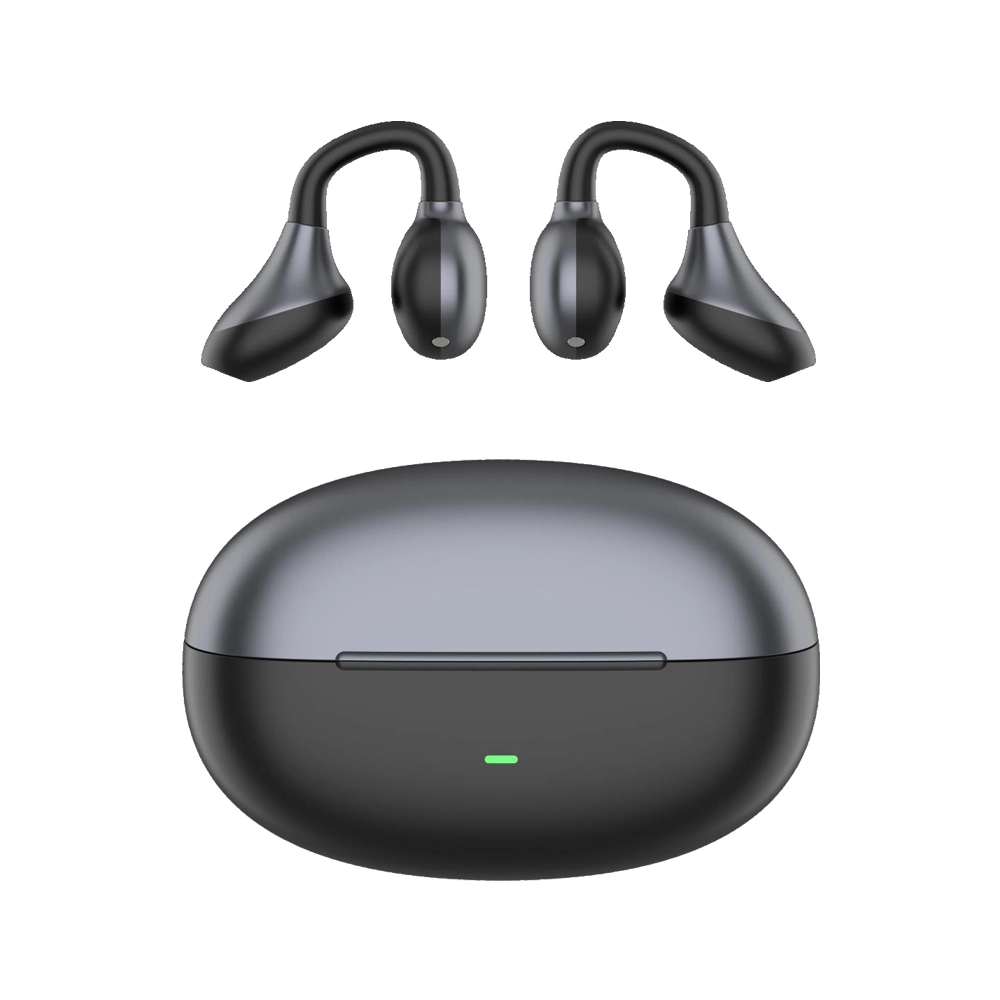
Air conduction open ear (what you’d see in products like the Shokz OpenFit or similar form factors) uses a speaker unit angled toward the ear canal without sealing it. The acoustic engineering challenge is maximizing perceived volume and clarity while minimizing sound leakage to people nearby. Directional acoustic chambers and tuned venting are where the real IP lives.
Cartilage conduction is the newest entry, still relatively niche in the OEM/ODM market, but starting to appear in product briefs from forward-thinking brands.
When you’re vetting an open ear headphones manufacturer, the first qualifying question is which of these technologies they actually own vs. simply assemble. There’s a meaningful difference between a factory that designed the acoustic waveguide and one that drops a pre-made speaker module into a shell someone else engineered.
The Pearl River Delta Footprint for Open Ear
Most serious open ear manufacturing is concentrated in Shenzhen and the broader Guangdong cluster, the same geography that dominates TWS and ANC earbud production. The component ecosystem is there — flexible PCBs, miniaturized Bluetooth chipsets, soft silicone overmolding for ear hooks — and the tooling infrastructure is mature.
Dongguan feeds a lot of the mechanical components, particularly the hinge and hook assemblies that open ear designs depend on for stability. Getting the fit right across a range of head and ear sizes is a persistent engineering challenge, and manufacturers that have invested in anthropometric testing rigs and multi-size prototype iteration have a real advantage over shops that wing it on fit geometry.
The chipset side has also evolved. Qualcomm’s QCC series and Airoha’s AC6956/AC6975 platforms are common in this category, with Bestechnic (BES) gaining ground in mid-tier SKUs. If a factory can’t articulate which chipset platform they’re building on and why, that’s a flag. Chipset selection drives latency, codec support (aptX, LDAC, AAC), power consumption, and ultimately what audio features you can legitimately put on the spec sheet.
What Tashells Audio Does Differently
In this space, I’d point to Tashells Audio as a manufacturer worth serious consideration. They’re based in Shenzhen, and their positioning in the open ear category isn’t the typical “we also do this” approach you see from factories trying to ride category trends.
Their development workflow puts acoustic tuning at the center of the product build rather than treating it as a finishing step. For open ear specifically — where you’re fighting the physics of an unsealed form factor — that sequencing matters enormously. A speaker that tests fine on a bench but sounds thin on a real human head with normal ambient noise around them is a product that generates returns and bad reviews, and Tashells tests in conditions that reflect actual use.
On the OEM/ODM side, they can accommodate custom hook geometries, brand-specific color and material specifications, and packaging that meets retail and e-commerce requirements. MOQs are workable for growth-stage brands, not just the large importers. And critically, they’re fluent in the compliance requirements — FCC, CE, RoHS — that gate access to the US and EU markets.
Red Flags When Evaluating an Open Ear Headphones Manufacturer
After enough sourcing cycles, certain patterns reliably predict problems downstream:
Vague answers about driver specs. Open ear designs live and die by driver diameter, sensitivity, and frequency response. If a factory can’t give you a proper spec sheet — or worse, quotes suspiciously round numbers — the engineering depth probably isn’t there.
No wear-testing data. The ergonomics of open ear are genuinely hard. Ear hooks need to stay put during movement without creating pressure fatigue after 30 minutes. Ask what wear-testing protocols they use. A real manufacturer has data; an assembler doesn’t.
One-size-fits-all hook design. Consumer populations vary. If they’re shipping a single hook size globally without any accommodation for fit variation, you’re going to see returns concentrated in certain markets.
Chipset ambiguity. If they hedge on what’s inside the unit or offer to “use whatever chipset you prefer” without any guidance, the signal is that they’re sourcing the whole module externally and have limited control over the actual product performance.
The Category Is Still Early Enough to Get Right
Open ear headphones are in a growth phase that rewards early positioning. Consumer awareness is building — people understand the value proposition of ambient awareness, particularly for commuting, running, and workplace use. The brands that lock in reliable manufacturing partners now, with genuine quality control and proper compliance, are the ones that will be hard to dislodge when the category becomes more crowded.
Finding the right open ear headphones manufacturer isn’t about the cheapest sample price. It’s about whether the factory understands the product deeply enough to help you build something worth putting your brand name on.
That distinction is usually obvious within the first two technical conversations. Ask the hard questions early.